


Page 387 - Structural Steel Designers Handbook AISC, AASHTO, AISI, ASTM, and ASCE-07 Design Standards
P. 387
Brockenbrough_Ch08.qxd  9/29/05  5:21 PM  Page 8.41


                                                       LATERAL-FORCE DESIGN


                                                                                   LATERAL-FORCE DESIGN  8.41


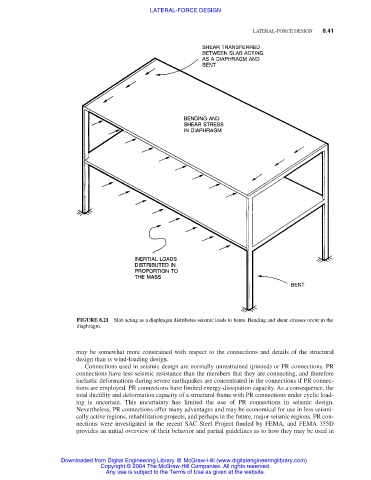
                                  FIGURE 8.21  Slab acting as a diaphragm distributes seismic loads to bents. Bending and shear stresses occur in the
                                  diaphragm.


                                  may be somewhat more constrained with respect to the connections and details of the structural
                                  design than is wind-loading design.
                                    Connections used in seismic design are normally unrestrained (pinned) or FR connections. PR
                                  connections have less seismic resistance than the members that they are connecting, and therefore
                                  inelastic deformations during severe earthquakes are concentrated in the connections if PR connec-
                                  tions are employed. PR connections have limited energy-dissipation capacity. As a consequence, the
                                  total ductility and deformation capacity of a structural frame with PR connections under cyclic load-
                                  ing is uncertain.  This uncertainty has limited the use of PR connections in seismic design.
                                  Nevertheless, PR connections offer many advantages and may be economical for use in less seismi-
                                  cally active regions, rehabilitation projects, and perhaps in the future, major seismic regions. PR con-
                                  nections were investigated in the recent SAC Steel Project funded by FEMA, and FEMA 355D
                                  provides an initial overview of their behavior and partial guidelines as to how they may be used in


                              Downloaded from Digital Engineering Library @ McGraw-Hill (www.digitalengineeringlibrary.com)
                                         Copyright © 2004 The McGraw-Hill Companies. All rights reserved.
                                          Any use is subject to the Terms of Use as given at the website.

