


Page 390 - Structural Steel Designers Handbook AISC, AASHTO, AISI, ASTM, and ASCE-07 Design Standards
P. 390
Brockenbrough_Ch09.qxd  9/29/05  5:25 PM  Page 9.2


                                                  COLD-FORMED STEEL DESIGN


                   9.2  CHAPTER NINE


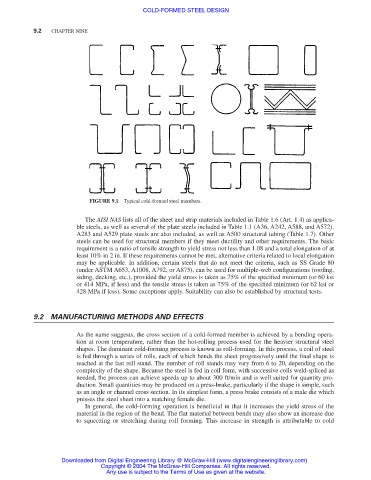
                                   FIGURE 9.1  Typical cold-formed steel members.

                                 The AISI NAS lists all of the sheet and strip materials included in Table 1.6 (Art. 1.4) as applica-
                               ble steels, as well as several of the plate steels included in Table 1.1 (A36, A242, A588, and A572).
                               A283 and A529 plate steels are also included, as well as A500 structural tubing (Table 1.7). Other
                               steels can be used for structural members if they meet ductility and other requirements. The basic
                               requirement is a ratio of tensile strength to yield stress not less than 1.08 and a total elongation of at
                               least 10% in 2 in. If these requirements cannot be met, alternative criteria related to local elongation
                               may be applicable. In addition, certain steels that do not meet the criteria, such as SS Grade 80
                               (under ASTM A653, A1008, A792, or A875), can be used for multiple-web configurations (roofing,
                               siding, decking, etc.), provided the yield stress is taken as 75% of the specified minimum (or 60 ksi
                               or 414 MPa, if less) and the tensile stress is taken as 75% of the specified minimum (or 62 ksi or
                               428 MPa if less). Some exceptions apply. Suitability can also be established by structural tests.


                   9.2 MANUFACTURING METHODS AND EFFECTS

                               As the name suggests, the cross section of a cold-formed member is achieved by a bending opera-
                               tion at room temperature, rather than the hot-rolling process used for the heavier structural steel
                               shapes. The dominant cold-forming process is known as roll-forming. In this process, a coil of steel
                               is fed through a series of rolls, each of which bends the sheet progressively until the final shape is
                               reached at the last roll stand. The number of roll stands may vary from 6 to 20, depending on the
                               complexity of the shape. Because the steel is fed in coil form, with successive coils weld-spliced as
                               needed, the process can achieve speeds up to about 300 ft/min and is well suited for quantity pro-
                               duction. Small quantities may be produced on a press-brake, particularly if the shape is simple, such
                               as an angle or channel cross section. In its simplest form, a press brake consists of a male die which
                               presses the steel sheet into a matching female die.
                                 In general, the cold-forming operation is beneficial in that it increases the yield stress of the
                               material in the region of the bend. The flat material between bends may also show an increase due
                               to squeezing or stretching during roll forming. This increase in strength is attributable to cold


                           Downloaded from Digital Engineering Library @ McGraw-Hill (www.digitalengineeringlibrary.com)
                                      Copyright © 2004 The McGraw-Hill Companies. All rights reserved.
                                       Any use is subject to the Terms of Use as given at the website.

