


Page 385 - Structural Steel Designers Handbook AISC, AASHTO, AISI, ASTM, and ASCE-07 Design Standards
P. 385
Brockenbrough_Ch08.qxd  9/29/05  5:21 PM  Page 8.39


                                                       LATERAL-FORCE DESIGN


                                                                                   LATERAL-FORCE DESIGN  8.39


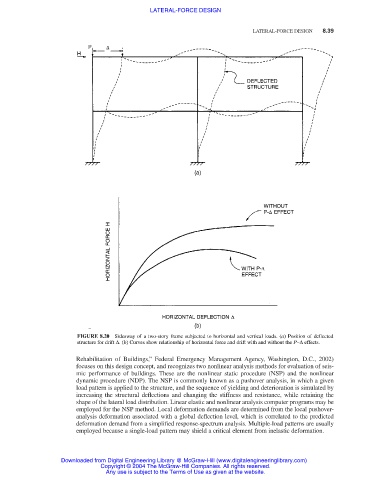
                                  FIGURE 8.20  Sidesway of a two-story frame subjected to horizontal and vertical loads. (a) Position of deflected
                                  structure for drift ∆. (b) Curves show relationship of horizontal force and drift with and without the P−∆ effects.

                                  Rehabilitation of Buildings,” Federal Emergency Management Agency,  Washington, D.C., 2002)
                                  focuses on this design concept, and recognizes two nonlinear analysis methods for evaluation of seis-
                                  mic performance of buildings. These are the nonlinear static procedure (NSP) and the nonlinear
                                  dynamic procedure (NDP). The NSP is commonly known as a pushover analysis, in which a given
                                  load pattern is applied to the structure, and the sequence of yielding and deterioration is simulated by
                                  increasing the structural deflections and changing the stiffness and resistance, while retaining the
                                  shape of the lateral load distribution. Linear elastic and nonlinear analysis computer programs may be
                                  employed for the NSP method. Local deformation demands are determined from the local pushover-
                                  analysis deformation associated with a global deflection level, which is correlated to the predicted
                                  deformation demand from a simplified response-spectrum analysis. Multiple-load patterns are usually
                                  employed because a single-load pattern may shield a critical element from inelastic deformation.


                              Downloaded from Digital Engineering Library @ McGraw-Hill (www.digitalengineeringlibrary.com)
                                         Copyright © 2004 The McGraw-Hill Companies. All rights reserved.
                                          Any use is subject to the Terms of Use as given at the website.

