


Page 331 - Structural Steel Designers Handbook AISC, AASHTO, AISI, ASTM, and ASCE-07 Design Standards
P. 331
Brockenbrough_Ch07.qxd  9/29/05  5:17 PM  Page 7.15


                                                     FLOOR AND ROOF SYSTEMS


                                                                                 FLOOR AND ROOF SYSTEMS  7.15


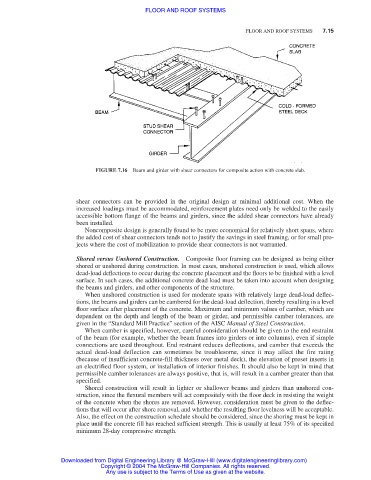
                                       FIGURE 7.16  Beam and girder with shear connectors for composite action with concrete slab.


                                  shear connectors can be provided in the original design at minimal additional cost.  When the
                                  increased loadings must be accommodated, reinforcement plates need only be welded to the easily
                                  accessible bottom flange of the beams and girders, since the added shear connectors have already
                                  been installed.
                                    Noncomposite design is generally found to be more economical for relatively short spans, where
                                  the added cost of shear connectors tends not to justify the savings in steel framing, or for small pro-
                                  jects where the cost of mobilization to provide shear connectors is not warranted.
                                  Shored versus Unshored Construction. Composite floor framing can be designed as being either
                                  shored or unshored during construction. In most cases, unshored construction is used, which allows
                                  dead-load deflections to occur during the concrete placement and the floors to be finished with a level
                                  surface. In such cases, the additional concrete dead load must be taken into account when designing
                                  the beams and girders, and other components of the structure.
                                    When unshored construction is used for moderate spans with relatively large dead-load deflec-
                                  tions, the beams and girders can be cambered for the dead-load deflection, thereby resulting in a level
                                  floor surface after placement of the concrete. Maximum and minimum values of camber, which are
                                  dependent on the depth and length of the beam or girder, and permissible camber tolerances, are
                                  given in the “Standard Mill Practice” section of the AISC Manual of Steel Construction.
                                    When camber is specified, however, careful consideration should be given to the end restraint
                                  of the beam (for example, whether the beam frames into girders or into columns), even if simple
                                  connections are used throughout. End restraint reduces deflections, and camber that exceeds the
                                  actual dead-load deflection can sometimes be troublesome, since it may affect the fire rating
                                  (because of insufficient concrete-fill thickness over metal deck), the elevation of preset inserts in
                                  an electrified floor system, or installation of interior finishes. It should also be kept in mind that
                                  permissible camber tolerances are always positive, that is, will result in a camber greater than that
                                  specified.
                                    Shored construction will result in lighter or shallower beams and girders than unshored con-
                                  struction, since the flexural members will act compositely with the floor deck in resisting the weight
                                  of the concrete when the shores are removed. However, consideration must be given to the deflec-
                                  tions that will occur after shore removal, and whether the resulting floor levelness will be acceptable.
                                  Also, the effect on the construction schedule should be considered, since the shoring must be kept in
                                  place until the concrete fill has reached sufficient strength. This is usually at least 75% of its specified
                                  minimum 28-day compressive strength.


                              Downloaded from Digital Engineering Library @ McGraw-Hill (www.digitalengineeringlibrary.com)
                                         Copyright © 2004 The McGraw-Hill Companies. All rights reserved.
                                          Any use is subject to the Terms of Use as given at the website.

