


Page 326 - Structural Steel Designers Handbook AISC, AASHTO, AISI, ASTM, and ASCE-07 Design Standards
P. 326
Brockenbrough_Ch07.qxd  9/29/05  5:16 PM  Page 7.10


                                                  FLOOR AND ROOF SYSTEMS


                   7.10  CHAPTER SEVEN

                               means with a field-operated seaming machine provided by the deck manufacturer. Some deck types
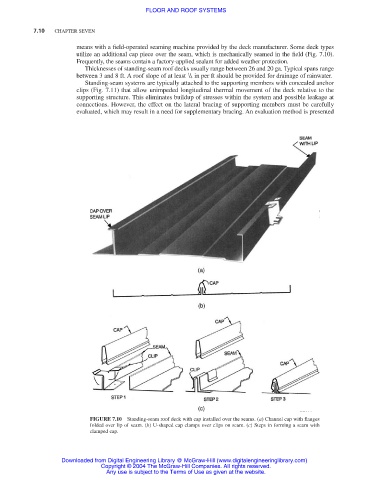
                               utilize an additional cap piece over the seam, which is mechanically seamed in the field (Fig. 7.10).
                               Frequently, the seams contain a factory-applied sealant for added weather protection.
                                 Thicknesses of standing-seam roof decks usually range between 26 and 20 ga. Typical spans range
                                                              1
                               between 3 and 8 ft. A roof slope of at least  / 4 in per ft should be provided for drainage of rainwater.
                                 Standing-seam systems are typically attached to the supporting members with concealed anchor
                               clips (Fig. 7.11) that allow unimpeded longitudinal thermal movement of the deck relative to the
                               supporting structure. This eliminates buildup of stresses within the system and possible leakage at
                               connections. However, the effect on the lateral bracing of supporting members must be carefully
                               evaluated, which may result in a need for supplementary bracing. An evaluation method is presented


                                   FIGURE 7.10  Standing-seam roof deck with cap installed over the seams. (a) Channel cap with flanges
                                   folded over lip of seam. (b) U-shaped cap clamps over clips on seam. (c) Steps in forming a seam with
                                   clamped cap.


                           Downloaded from Digital Engineering Library @ McGraw-Hill (www.digitalengineeringlibrary.com)
                                      Copyright © 2004 The McGraw-Hill Companies. All rights reserved.
                                       Any use is subject to the Terms of Use as given at the website.

