


Page 325 - Structural Steel Designers Handbook AISC, AASHTO, AISI, ASTM, and ASCE-07 Design Standards
P. 325
Brockenbrough_Ch07.qxd  9/29/05  5:16 PM  Page 7.9


                                                     FLOOR AND ROOF SYSTEMS


                                                                                  FLOOR AND ROOF SYSTEMS  7.9

                                                        ROOF DECKS

                                  The systems used for floor decks (Arts. 7.1 to 7.3) can also be used for roof decks. When used as
                                  roof decks, these systems are overlaid by roofing materials, to provide a weathertight enclosure.
                                  Other roof-deck systems are described in Arts. 7.4 to 7.7.

                      7.4 METAL ROOF DECK


                                  Steel-framed buildings often utilize a roof deck composed simply of metal deck. When properly sloped
                                  for drainage, the metal deck itself can serve as a watertight enclosure. Alternatively, roofing materials
                                  can be placed on top of the deck. In either case, diaphragm action can be achieved by proper sizing and
                                  attachment of the metal deck. A fire rating can be provided by applying spray-on fire protection to the
                                  underside of the roof deck, or by installing a fire-rated ceiling system below the deck.
                                    Metal roof deck usually is used for noncomposite construction. It is commonly available in depths of
                                   1
                                                                                        1
                                                                                1
                                  1 / 2, 2, and 3 in. Long-span roof deck is available with depths of 4 / 2, 6, and 7 / 2 in from some manufac-
                                  turers. Cellular roof deck is sometimes used to provide a smooth soffit. When a lightweight insulating
                                  concrete fill is placed over the roof deck, the deck should be galvanized and also vented (perforated) to
                                  accelerate the drying time of the insulating fill, and prevent entrapment of water vapor. Acoustical deck
                                  is also available for use in applications where enhanced sound absorption is desired.
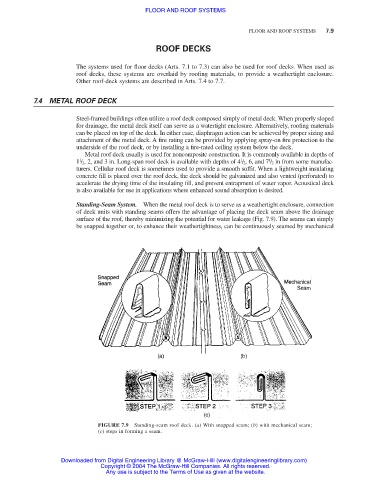
                                  Standing-Seam System. When the metal roof deck is to serve as a weathertight enclosure, connection
                                  of deck units with standing seams offers the advantage of placing the deck seam above the drainage
                                  surface of the roof, thereby minimizing the potential for water leakage (Fig. 7.9). The seams can simply
                                  be snapped together or, to enhance their weathertightness, can be continuously seamed by mechanical


                                        FIGURE 7.9  Standing-seam roof deck. (a) With snapped seam; (b) with mechanical seam;
                                        (c) steps in forming a seam.


                              Downloaded from Digital Engineering Library @ McGraw-Hill (www.digitalengineeringlibrary.com)
                                         Copyright © 2004 The McGraw-Hill Companies. All rights reserved.
                                          Any use is subject to the Terms of Use as given at the website.

