


Page 181 - Materials Chemistry, Second Edition
P. 181
Ch005-P373623.qxd  3/22/07  5:34 PM  Page 160
                     Sustainable Industrial Design and Waste Management
                160
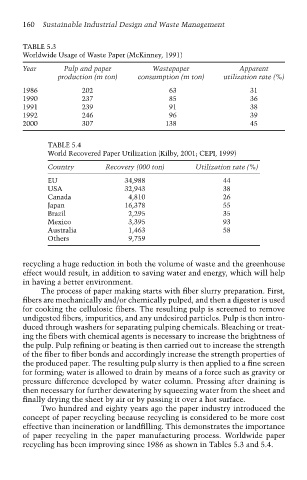
                TABLE 5.3
                Worldwide Usage of Waste Paper (McKinney, 1991)
                Year       Pulp and paper          Wastepaper             Apparent
                         production (m ton)    consumption (m ton)    utilization rate (%)
                1986            202                    63                    31
                1990            237                    85                    36
                1991            239                    91                    38
                1992            246                    96                    39
                2000            307                   138                    45

                       TABLE 5.4
                       World Recovered Paper Utilization (Kilby, 2001; CEPI, 1999)
                       Country        Recovery (000 ton)      Utilization rate (%)
                       EU                  34,988                    44
                       USA                 32,943                    38
                       Canada               4,810                    26
                       Japan               16,378                    55
                       Brazil               2,295                    35
                       Mexico               3,395                    93
                       Australia            1,463                    58
                       Others               9,759


                recycling a huge reduction in both the volume of waste and the greenhouse
                effect would result, in addition to saving water and energy, which will help
                in having a better environment.
                     The process of paper making starts with fiber slurry preparation. First,
                fibers are mechanically and/or chemically pulped, and then a digester is used
                for cooking the cellulosic fibers. The resulting pulp is screened to remove
                undigested fibers, impurities, and any undesired particles. Pulp is then intro-
                duced through washers for separating pulping chemicals. Bleaching or treat-
                ing the fibers with chemical agents is necessary to increase the brightness of
                the pulp. Pulp refining or beating is then carried out to increase the strength
                of the fiber to fiber bonds and accordingly increase the strength properties of
                the produced paper. The resulting pulp slurry is then applied to a fine screen
                for forming; water is allowed to drain by means of a force such as gravity or
                pressure difference developed by water column. Pressing after draining is
                then necessary for further dewatering by squeezing water from the sheet and
                finally drying the sheet by air or by passing it over a hot surface.
                     Two hundred and eighty years ago the paper industry introduced the
                concept of paper recycling because recycling is considered to be more cost
                effective than incineration or landfilling. This demonstrates the importance
                of paper recycling in the paper manufacturing process. Worldwide paper
                recycling has been improving since 1986 as shown in Tables 5.3 and 5.4.

