


Page 178 - Materials Chemistry, Second Edition
P. 178
Ch005-P373623.qxd  3/22/07  5:34 PM  Page 157
                     Organic mixed  Sustainability of Municipal Solid Waste Management  157
                       with rejects            Collection


                    Composting plant          Conveyor belt


                                           Paper
                  Rejects    Compost       Metal       Glass            Plastics
                                          Textile


                                                      Crushed     Thin film    Hard
                               Sand        Press
                                                       glass      plastics    plastics


                        Bricks           Compacted
                       Interlocks         wastes
                        Wheels           for recycling
                        Tables
                       Manholes
                      Road ramps

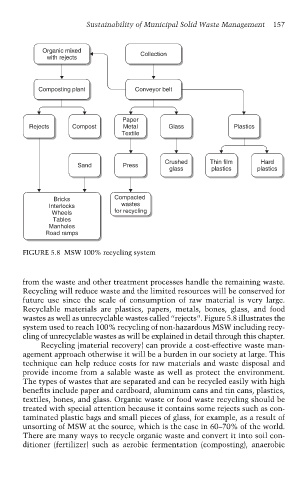
                FIGURE 5.8 MSW 100% recycling system


                from the waste and other treatment processes handle the remaining waste.
                Recycling will reduce waste and the limited resources will be conserved for
                future use since the scale of consumption of raw material is very large.
                Recyclable materials are plastics, papers, metals, bones, glass, and food
                wastes as well as unrecyclable wastes called “rejects”. Figure 5.8 illustrates the
                system used to reach 100% recycling of non-hazardous MSW including recy-
                cling of unrecyclable wastes as will be explained in detail through this chapter.
                     Recycling (material recovery) can provide a cost-effective waste man-
                agement approach otherwise it will be a burden in our society at large. This
                technique can help reduce costs for raw materials and waste disposal and
                provide income from a salable waste as well as protect the environment.
                The types of wastes that are separated and can be recycled easily with high
                benefits include paper and cardboard, aluminum cans and tin cans, plastics,
                textiles, bones, and glass. Organic waste or food waste recycling should be
                treated with special attention because it contains some rejects such as con-
                taminated plastic bags and small pieces of glass, for example, as a result of
                unsorting of MSW at the source, which is the case in 60–70% of the world.
                There are many ways to recycle organic waste and convert it into soil con-
                ditioner (fertilizer) such as aerobic fermentation (composting), anaerobic

