


Page 175 - Materials Chemistry, Second Edition
P. 175
Ch005-P373623.qxd  3/22/07  5:34 PM  Page 154
                     Sustainable Industrial Design and Waste Management
                154
                TABLE 5.2
                Generation and Recovery of Materials in MSW (EPA, 2005)
                                          Weight           Weight          Recovery as
                                         generated        recovered        percent of
                                       (million tons)   (million tons)   generation (%)
                Paper and paperboard       83.1            40                 48.1
                Glass                      12.5             2.35              18.8
                Metals
                Steel                      14               5.09              36.4
                Aluminum                    3.23            0.69              21.4
                Other non-ferrous metals    1.59            1.06              66.7
                Plastics                   26.7             1.39               5.2
                Rubber and leather          6.82            1.1               16.1
                Textiles                   10.6             1.52              14.3
                Wood                       13.6             1.28               9.4
                Other materials             4.32            0.98              22.7
                Other wastes
                Food, other                27.6             0.75               2.7
                Yard trimmings             28.6            16.1               56.3
                Miscellaneous               3.62             —            less than 0.05
                  inorganic wastes
                TOTAL MSW                 236.28           72.31              30.6


                     • Release of greenhouse gases into the atmosphere through methane
                       release or carbon dioxide from emissions.
                     • Groundwater contamination from uncontrolled leachate in dump
                       sites.

                In addition, landfilling is not the best utilization practice for the land use
                plans. Accordingly nations are attempting to enhance solid waste manage-
                ment in sustainable systems and increase recycling options, which is the main
                objective of this book.
                     According to US-EPA in 2005: “In 1999, recycling and composting pre-
                vented over 60 million tons of materials from ending up in landfills. Today,
                the U.S. recycles over 28% of all its wastes, a number which has doubled in
                the past fifteen years. 42% of all paper, 40% of all plastic bottles, 55% of all
                drink cans, 57% of all steel packaging and 52% of all major appliances are now
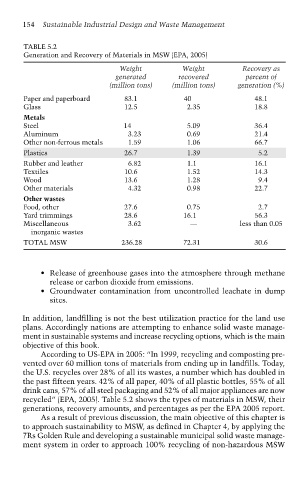
                recycled” (EPA, 2005). Table 5.2 shows the types of materials in MSW, their
                generations, recovery amounts, and percentages as per the EPA 2005 report.
                     As a result of previous discussion, the main objective of this chapter is
                to approach sustainability to MSW, as defined in Chapter 4, by applying the
                7Rs Golden Rule and developing a sustainable municipal solid waste manage-
                ment system in order to approach 100% recycling of non-hazardous MSW

