


Page 357 - Sustainable On-Site CHP Systems Design, Construction, and Operations
P. 357
330    Ca s e  S t u d y 1


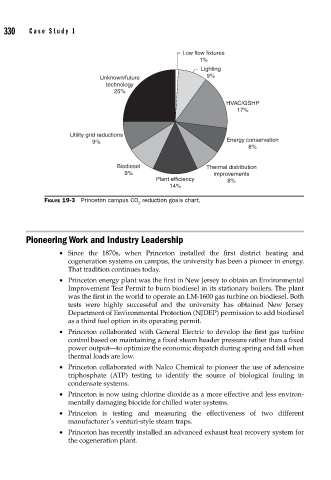
                                                    Low flow fixtures
                                                        1%
                                                         Lighting
                             Unknown/future                9%
                              technology
                                 25%
                                                                HVAC/GSHP
                                                                   17%


                    Utility grid reductions
                           9%                                   Energy conservation
                                                                      8%

                                  Biodiesel               Thermal distribution
                                    9%                      improvements
                                            Plant efficiency    8%
                                                14%

             FIGURE 19-3  Princeton campus CO  reduction goals chart.
                                       2


        Pioneering Work and Industry Leadership

                 •  Since the 1870s, when Princeton installed the first district heating and
                    cogeneration systems on campus, the university has been a pioneer in energy.
                    That tradition continues today.
                 •  Princeton energy plant was the first in New Jersey to obtain an Environmental
                    Improvement Test Permit to burn biodiesel in its stationary boilers. The plant
                    was the first in the world to operate an LM-1600 gas turbine on biodiesel. Both
                    tests were highly successful and the university has obtained New Jersey
                    Department of Environmental Protection (NJDEP) permission to add biodiesel
                    as a third fuel option in its operating permit.
                 •  Princeton collaborated with General Electric to develop the first gas turbine
                    control based on maintaining a fixed steam header pressure rather than a fixed
                    power output—to optimize the economic dispatch during spring and fall when
                    thermal loads are low.
                 •  Princeton collaborated with Nalco Chemical to pioneer the use of adenosine
                    triphosphate (ATP) testing to identify the source of biological fouling in
                    condensate systems.
                 •  Princeton is now using chlorine dioxide as a more effective and less environ-
                    mentally damaging biocide for chilled water systems.
                 •  Princeton is testing and measuring the effectiveness of two different
                    manufacturer’s venturi-style steam traps.
                 •  Princeton has recently installed an advanced exhaust heat recovery system for
                    the cogeneration plant.

