


Page 353 - Sustainable On-Site CHP Systems Design, Construction, and Operations
P. 353
326    Ca s e  S t u d y 1


             burn natural gas, while the boilers and gas turbine are capable of firing natural gas or
             diesel fuel.
                The boilers are approximately 83 percent efficient when firing using natural gas and
             87 percent when firing with No. 2 diesel fuel. The duct firing process is approximately
             82 percent efficient. The boilers were installed in 1996.
             Steam Distribution and Condensate Collection
             Steam at 225 psig is delivered to the steam turbines in the chilled water plant for use in
             chilled water production. Additional steam is delivered to the campus to serve space
             heating and research needs. Main steam pressure is 220 psig. This is reduced to 45 to
             90 psig in the distribution system, and dropped below 15 psig at each building entrance.
                The campus steam distribution network consists of insulated carbon steel piping in
             small steam and condensate tunnels and larger multiutility walk-through tunnels.
             Some condensate piping is direct buried. Condensate is pumped back to the plant with
             typical recovery of 75 to 85 percent. This high rate of recovery results in a minimum of
             water, chemical, and thermal waste.
                An ongoing condensate recovery improvement program involving plant opera-
             tions, campus maintenance, and facilities engineering staff identifies problems and
             targets areas of opportunity to improve the campus condensate recovery rate. In recent
             years, this program has lead to the repair or replacement of dozens of condensate pumps,
             added thermal insulation to thousands of feet of pipe, tested and planned replacement
             and upgraded hundreds of steam traps.

             Chilled Water Production
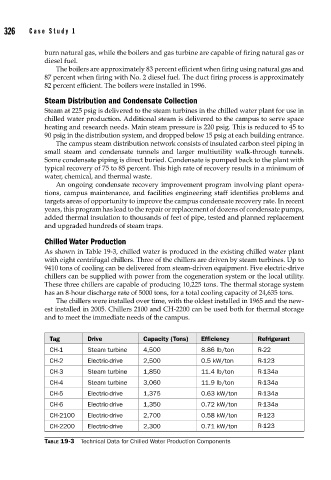
             As shown in Table 19-3, chilled water is produced in the existing chilled water plant
             with eight centrifugal chillers. Three of the chillers are driven by steam turbines. Up to
             9410 tons of cooling can be delivered from steam-driven equipment. Five electric-drive
             chillers can be supplied with power from the cogeneration system or the local utility.
             These three chillers are capable of producing 10,225 tons. The thermal storage system
             has an 8-hour discharge rate of 5000 tons, for a total cooling capacity of 24,635 tons.
                The chillers were installed over time, with the oldest installed in 1965 and the new-
             est installed in 2005. Chillers 2100 and CH-2200 can be used both for thermal storage
             and to meet the immediate needs of the campus.


               Tag       Drive           Capacity (Tons)  Efficiency     Refrigerant
               CH-1      Steam turbine   4,500           8.86 lb/ton     R-22
               CH-2      Electric-drive  2,500           0.5 kW/ton      R-123
               CH-3      Steam turbine   1,850           11.4 lb/ton     R-134a
               CH-4      Steam turbine   3,060           11.9 lb/ton     R-134a
               CH-5      Electric-drive  1,375           0.63 kW/ton     R-134a
               CH-6      Electric-drive  1,350           0.72 kW/ton     R-134a
               CH-2100   Electric-drive  2,700           0.58 kW/ton     R-123
               CH-2200   Electric-drive  2,300           0.71 kW/ton     R-123

             TABLE 19-3  Technical Data for Chilled Water Production Components

