


Page 351 - Sustainable On-Site CHP Systems Design, Construction, and Operations
P. 351
324    Ca s e  S t u d y 1


             Dillon Gym mechanical room. These produce approximately 500 kW while controlling
             the steam pressure between the 200-psig high-pressure distribution system and the 15-
             psig low-pressure distribution system on campus. This was the first installation where
             two Microsteam systems have been operated in parallel.


        Central Energy Plant and Systems
             Princeton’s central energy plant provides up to 15 MW of electricity, 300,000 pounds per
             hour (pph) of steam, and 25,000 tons of cooling to the campus. Major production equip-
             ment includes: a GE LM-1600 gas turbine, a Nebraska Boiler heat recovery steam genera-
             tor, two dual fuel Indeck auxiliary boilers, five electric chillers, three steam-driven chillers,
             and a 40,000 ton-h thermal storage system. This varied mix allows Princeton to provide
             electricity and thermal energy in a reliable and efficient manner to the university campus.
             Through careful design and operation, the energy plant saves millions of dollars for the
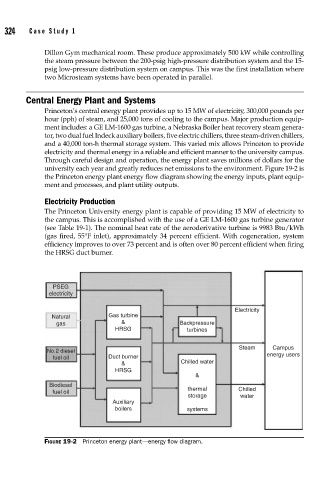
             university each year and greatly reduces net emissions to the environment. Figure 19-2 is
             the Princeton energy plant energy flow diagram showing the energy inputs, plant equip-
             ment and processes, and plant utility outputs.

             Electricity Production
             The Princeton University energy plant is capable of providing 15 MW of electricity to
             the campus. This is accomplished with the use of a GE LM-1600 gas turbine generator
             (see Table 19-1). The nominal heat rate of the aeroderivative turbine is 9983 Btu/kWh
             (gas fired, 55°F inlet), approximately 34 percent efficient. With cogeneration, system
             efficiency improves to over 73 percent and is often over 80 percent efficient when firing
             the HRSG duct burner.


                PSEG
               electricity

                                                                  Electricity
               Natural         Gas turbine
                 gas               &               Backpressure
                                 HRSG                turbines


                                                                   Steam     Campus
              No.2 diesel                                                  energy users
                fuel oil       Duct burner
                                   &               Chilled water
                                 HRSG
                                                       &
               Biodiesel
                                                     thermal       Chilled
                fuel oil
                                                     storage        water
                                Auxiliary
                                 boilers             systems


             FIGURE 19-2  Princeton energy plant—energy fl ow diagram.

