


Page 352 - Sustainable On-Site CHP Systems Design, Construction, and Operations
P. 352
Princeton University District Ener gy System    325


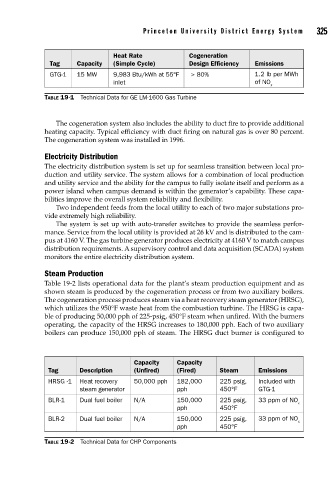
                                Heat Rate             Cogeneration
               Tag    Capacity  (Simple Cycle)        Design Efficiency   Emissions
               GTG-1  15 MW     9,983 Btu/kWh at 55°F    > 80%          1.2 lb per MWh
                                inlet                                   of NO
                                                                            x
             TABLE 19-1  Technical Data for GE LM-1600 Gas Turbine


                The cogeneration system also includes the ability to duct fire to provide additional
             heating capacity. Typical efficiency with duct firing on natural gas is over 80 percent.
             The cogeneration system was installed in 1996.

             Electricity Distribution
             The electricity distribution system is set up for seamless transition between local pro-
             duction and utility service. The system allows for a combination of local production
             and utility service and the ability for the campus to fully isolate itself and perform as a
             power island when campus demand is within the generator’s capability. These capa-
             bilities improve the overall system reliability and flexibility.
                Two independent feeds from the local utility to each of two major substations pro-
             vide extremely high reliability.
                The system is set up with auto-transfer switches to provide the seamless perfor-
             mance. Service from the local utility is provided at 26 kV and is distributed to the cam-
             pus at 4160 V. The gas turbine generator produces electricity at 4160 V to match campus
             distribution requirements. A supervisory control and data acquisition (SCADA) system
             monitors the entire electricity distribution system.
             Steam Production
             Table 19-2 lists operational data for the plant’s steam production equipment and as
             shown steam is produced by the cogeneration process or from two auxiliary boilers.
             The cogeneration process produces steam via a heat recovery steam generator (HRSG),
             which utilizes the 950°F waste heat from the combustion turbine. The HRSG is capa-
             ble of producing 50,000 pph of 225-psig, 450°F steam when unfired. With the burners
             operating, the capacity of the HRSG increases to 180,000 pph. Each of two auxiliary
             boilers can produce 150,000 pph of steam. The HRSG duct burner is configured to


                                      Capacity    Capacity
              Tag      Description    (Unfired)   (Fired)     Steam      Emissions
              HRSG -1  Heat recovery   50,000 pph  182,000    225 psig,   Included with
                       steam generator            pph         450°F      GTG-1
              BLR-1    Dual fuel boiler  N/A      150,000     225 psig,   33 ppm of NO
                                                                                    x
                                                  pph         450°F
              BLR-2    Dual fuel boiler  N/A      150,000     225 psig,   33 ppm of NO
                                                                                    x
                                                  pph         450°F
             TABLE 19-2  Technical Data for CHP Components

