


Page 407 - Sustainable On-Site CHP Systems Design, Construction, and Operations
P. 407
380    Ca s e  S t u d y 5


                Facility Outage Impacts          Annual Outages        Annual Cost
         Power Quality  Outage   Facility    Occurrences  Total Annual  Outage  Total
         Disruptions  Duration per  Disruption   per Year  Facility   Cost per  Annual
                      Occurrence  per                   Disruption  Hour     Costs
                                 Occurrence
         Momentary    5.3 seconds  0.5 hours  2.5       1.3 hours   $45,000  $56,250
         interruptions
         Long duration  60 minutes  5.0 hours  0.5      2.5 hours   $45,000  $112,500
         interruptions
         TOTAL                               3          3.8                  $168,750
         Unserved kWh per hour (based on a   1500 kWh
         1500-kW average demand
         Customer’s estimated value of service   $30/unserved kWh
         ($/unserved kWh)
         Normalized annual outage costs      $113 $/kW-year
         ($/kW-year)

        Note: This table is an example of how to quantify the cost of facility disruptions due to both momentary and
         long-term outages. The number of occurrences in this example is based on data obtained by EPRI from PG&E
         customers. The disruption caused by a particular type of outage is customer specific.

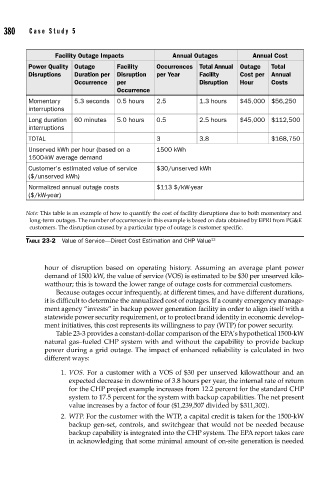
        TABLE 23-2  Value of Service—Direct Cost Estimation and CHP Value 12


             hour of disruption based on operating history.  Assuming an average plant power
             demand of 1500 kW, the value of service (VOS) is estimated to be $30 per unserved kilo-
             watthour; this is toward the lower range of outage costs for commercial customers.
                Because outages occur infrequently, at different times, and have different durations,
             it is difficult to determine the annualized cost of outages. If a county emergency manage-
             ment agency “invests” in backup power generation facility in order to align itself with a
             statewide power security requirement, or to protect brand identity in economic develop-
             ment initiatives, this cost represents its willingness to pay (WTP) for power security.
                Table 23-3 provides a constant-dollar comparison of the EPA’s hypothetical 1500-kW
             natural gas–fueled CHP system with and without the capability to provide backup
             power during a grid outage. The impact of enhanced reliability is calculated in two
             different ways:

                  1. VOS. For a customer with a VOS of $30 per unserved kilowatthour and an
                    expected decrease in downtime of 3.8 hours per year, the internal rate of return
                    for the CHP project example increases from 12.2 percent for the standard CHP
                    system to 17.5 percent for the system with backup capabilities. The net present
                    value increases by a factor of four ($1,239,507 divided by $311,302).
                  2. WTP. For the customer with the WTP, a capital credit is taken for the 1500-kW
                    backup gen-set, controls, and switchgear that would not be needed because
                    backup capability is integrated into the CHP system. The EPA report takes care
                    in acknowledging that some minimal amount of on-site generation is needed

