


Page 436 - Tandem Techniques
P. 436
Page 419

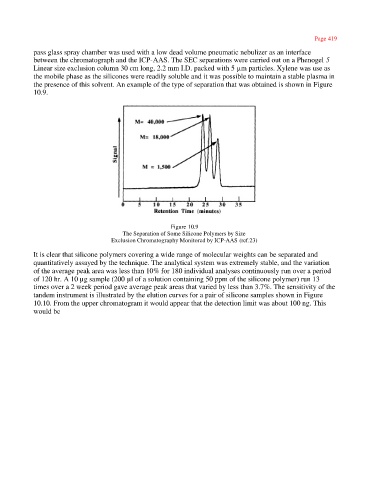
            pass glass spray chamber was used with a low dead volume pneumatic nebulizer as an interface
            between the chromatograph and the ICP-AAS. The SEC separations were carried out on a Phenogel 5
            Linear size exclusion column 30 cm long, 2.2 mm I.D. packed with 5 µm particles. Xylene was use as
            the mobile phase as the silicones were readily soluble and it was possible to maintain a stable plasma in
            the presence of this solvent. An example of the type of separation that was obtained is shown in Figure
            10.9.


                                                         Figure 10.9
                                         The Separation of Some Silicone Polymers by Size
                                      Exclusion Chromatography Monitored by ICP-AAS (ref.23)

            It is clear that silicone polymers covering a wide range of molecular weights can be separated and
            quantitatively assayed by the technique. The analytical system was extremely stable, and the variation
            of the average peak area was less than 10% for 180 individual analyses continuously run over a period
            of 120 hr. A 10 µg sample (200 µl of a solution containing 50 ppm of the silicone polymer) run 13
            times over a 2 week period gave average peak areas that varied by less than 3.7%. The sensitivity of the
            tandem instrument is illustrated by the elution curves for a pair of silicone samples shown in Figure
            10.10. From the upper chromatogram it would appear that the detection limit was about 100 ng. This
            would be

