


Page 444 - Tandem Techniques
P. 444
Page 427

            Ahmad et al. [27] utilized an alumina column in conjunction with a direct current plasma emission
            spectrometer (Spectraspan V. Beckman Instruments) to determine the speciation of chromium in
            aqueous samples. The column was 10 cm long, 4.0 mm I.D. and the outlet of the columns was
            connected directly to the peristaltic pump inlet system of the spectrometer. The arrangement was
            extremely simple and provided very useful sensitivity. The peaks for Cr  and Cr  from four repetitive
                                                                                 III
                                                                                          VI
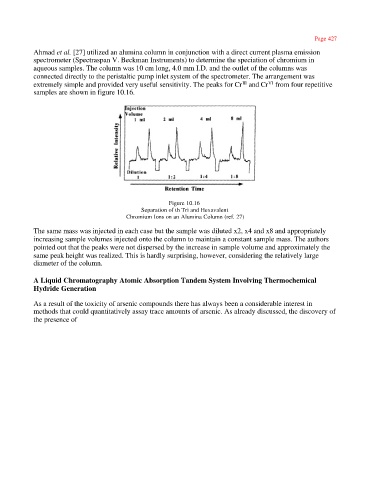
            samples are shown in figure 10.16.


                                                         Figure 10.16
                                                Separation of th Tri and Hexavalent
                                           Chromium Ions on an Alumina Column (ref. 27)

            The same mass was injected in each case but the sample was diluted x2, x4 and x8 and appropriately
            increasing sample volumes injected onto the column to maintain a constant sample mass. The authors
            pointed out that the peaks were not dispersed by the increase in sample volume and approximately the
            same peak height was realized. This is hardly surprising, however, considering the relatively large
            diameter of the column.


            A Liquid Chromatography Atomic Absorption Tandem System Involving Thermochemical
            Hydride Generation

            As a result of the toxicity of arsenic compounds there has always been a considerable interest in
            methods that could quantitatively assay trace amounts of arsenic. As already discussed, the discovery of
            the presence of

