


Page 69 - The Art of Designing Embedded Systems
P. 69
56  THE  ART OF  DESIGNING EMBEDDED SYSTEMS


                            Last instruction before intr                   ISR start
                                           Pushes from intr      Vector read
                                                                  m
                         / rd                                    U     U

                          INTR   i

                         /intak
                         /wr              U     U      U


                                    0100   7FFE   7FFC   7FFA    I   0010 1  0012  I  0020

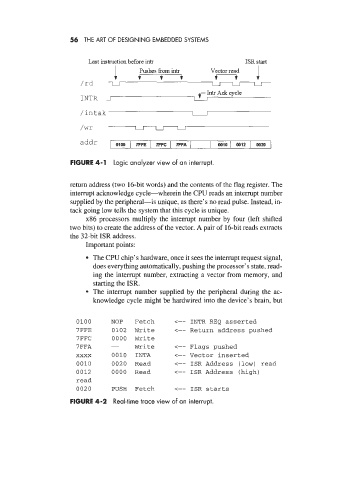
                      FIGURE 4-1  Logic analyzer view of an interrupt.


                      return address (two 16-bit words) and the contents of the flag register. The
                      interrupt acknowledge cycle-wherein  the CPU reads an interrupt number
                      supplied by the peripheral-is  unique, as there’s no read pulse. Instead, in-
                      tack going low tells the system that this cycle is unique.
                           x86 processors  multiply  the interrupt  number by  four (left shifted
                      two bits) to create the address of the vector. A pair of  16-bit reads extracts
                      the 32-bit ISR address.
                           Important points:
                             The CPU chip’s hardware, once it sees the interrupt request signal,
                             does everything automatically, pushing the processor’s state, read-
                             ing the interrupt number, extracting a vector from memory, and
                             starting the ISR.
                             The interrupt number supplied  by  the peripheral  during the  ac-
                             knowledge cycle might be hardwired into the device’s brain, but


                        0100       NOP    Fetch       <--   INTR REQ asserted
                        7FFE       0102  Write        <--  Return address pushed
                        7FFC       0000  Write
                        7FFA       -  Write           <--  Flags pushed
                        xxxx       0010  INTA         <--  Vector inserted
                        0010       0020  Read         <--   ISR Address  (low) read
                        0012       0000  Read         <--   ISR Address  (high)
                        read
                        0020       PUSH  Fetch        <--   ISR starts
                      FIGURE 4-2  Real-time trace view of an interrupt.

