


Page 71 - The Art of Designing Embedded Systems
P. 71
58  THE ART OF  DESIGNING EMBEDDED SYSTEMS

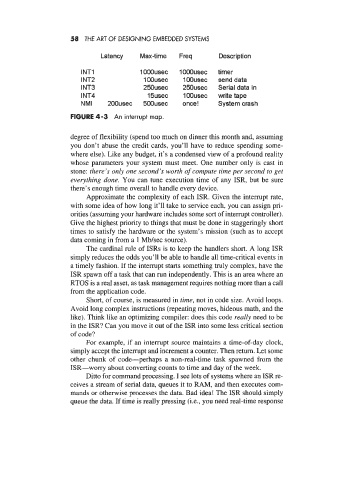
                                Latency    Max-time    Freq        Description

                          lNTl             1 OOOusec   1 OOOusec   timer
                          I NT2              1 OOusec   1 OOusec   send data
                          I NT3             250usec     250usec    Serial data in
                          I NT4               15usec     1 OOusec   write tape
                          NMI     200usec   5OOusec     once!      System crash
                       FIGURE 4-3  An interrupt map.


                      degree of flexibility (spend too much on dinner this month and, assuming
                      you don’t abuse the credit cards, you’ll have to reduce spending some-
                      where else). Like any budget, it’s a condensed view of a profound reality
                      whose parameters  your  system must meet. One number only is cast  in
                      stone: there’s only one second’s worth of compute time per second to get
                      everything done. You can tune execution time of  any ISR, but be  sure
                      there’s enough time overall to handle every device.
                           Approximate the complexity of each ISR. Given the interrupt rate,
                      with some idea of how long it’ll take to service each, you can assign pri-
                      orities (assuming your hardware includes some sort of interrupt controller).
                      Give the highest priority to things that must be done in staggeringly short
                      times to satisfy the hardware or the system’s mission (such as to accept
                      data coming in from a 1 Mb/sec source).
                           The cardinal rule of ISRs is to keep the handlers short. A long ISR
                      simply reduces the odds you’ll be able to handle all time-critical events in
                      a timely fashion. If the interrupt starts something truly complex, have the
                      ISR spawn off a task that can run independently. This is an area where an
                      RTOS is a real asset, as task management requires nothing more than a call
                      from the application code.
                           Short, of course, is measured in time, not in code size. Avoid loops.
                      Avoid long complex instructions (repeating moves, hideous math, and the
                      like). Think like an optimizing compiler: does this code really need to be
                      in the ISR? Can you move it out of the ISR into some less critical section
                      of code?
                           For example, if an interrupt source maintains a time-of-day clock,
                      simply accept the interrupt and increment a counter. Then return. Let some
                      other chunk of  code-perhaps   a  non-real-time  task  spawned  from  the
                      ISR-worry  about converting counts to time and day of the week.
                           Ditto for command processing. I see lots of systems where an ISR re-
                      ceives a stream of serial data, queues it to RAM, and then executes com-
                      mands or otherwise processes the data. Bad idea! The ISR should simply
                      queue the data. If time is really pressing &e., you need real-time response

