


Page 85 - The CNN Effect in Action - How the News Media Pushed the West toward War ini Kosovo
P. 85
1403975191ts04.qxd  19-2-07  05:07 PM  Page 60
                                                         60
                                                                THE CNN EFFECT IN ACTION
                                                         strategic policy?” For example, if the strategic policy is to end a civil
                                                         war, the parties may need to stop fighting and start negotiating. If it
                                                         is to stop a man-induced humanitarian crisis, the parties may need to
                                                         cooperate and support the efforts of an intervening force.
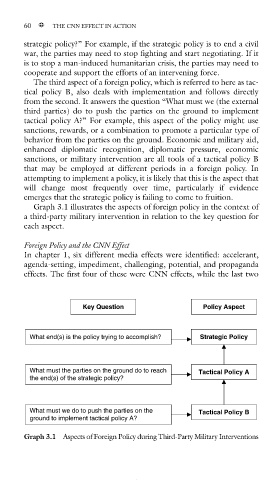
                                                           The third aspect of a foreign policy, which is referred to here as tac-
                                                         tical policy B, also deals with implementation and follows directly
                                                         from the second. It answers the question “What must we (the external
                                                         third parties) do to push the parties on the ground to implement
                                                         tactical policy A?” For example, this aspect of the policy might use
                                                         sanctions, rewards, or a combination to promote a particular type of
                                                         behavior from the parties on the ground. Economic and military aid,
                                                         enhanced diplomatic recognition, diplomatic pressure, economic
                                                         sanctions, or military intervention are all tools of a tactical policy B
                                                         that may be employed at different periods in a foreign policy. In
                                                         attempting to implement a policy, it is likely that this is the aspect that
                                                         will change most frequently over time, particularly if evidence
                                                         emerges that the strategic policy is failing to come to fruition.
                                                           Graph 3.1 illustrates the aspects of foreign policy in the context of
                                                         a third-party military intervention in relation to the key question for
                                                         each aspect.
                                                         Foreign Policy and the CNN Effect
                                                         In chapter 1, six different media effects were identified: accelerant,
                                                         agenda-setting, impediment, challenging, potential, and propaganda
                                                         effects. The first four of these were CNN effects, while the last two
                                                                        Key Question                  Policy Aspect
                                                          What end(s) is the policy trying to accomplish?  Strategic Policy
                                                          What must the parties on the ground do to reach  Tactical Policy A
                                                          the end(s) of the strategic policy?
                                                          What must we do to push the parties on the   Tactical Policy B
                                                          ground to implement tactical policy A?
                                                         Graph 3.1 Aspects of Foreign Policy during Third-Party Military Interventions

