


Page 686 - The Mechatronics Handbook
P. 686
system that adds a single additional error. By documenting relationships such as composition and inher-
                                 itance, requirements and the interdependence of requirements can be represented in a compact and
                                 comprehensible way.
                                   One key aspect of the requirements definition phase is the importance of defining requirements without
                                 specifying a preferred solution embodiment. Hence, modeling methods should be chosen to document
                                 these requirements and their intrinsic relationships without implying a particular solution.

                                 Phase 2

                                 In the concept generation phase, our objective is to generate multiple design concepts that might satisfy
                                 the requirements identified in phase 1. Here we need modeling techniques that allow us to describe
                                 possible solutions with varying levels of detail dependent on the degree of detail needed to document
                                 the key elements of the concept. Since individual concepts generated in this phase may only satisfy some
                                 portions of the design requirements, it is critical that modeling at this point allow for partial descriptions
                                 of embodiments and for the easy combination of design concepts. For this reason, our models must
                                 clearly document the portions of the requirements satisfied as well as any unspecified parameters or
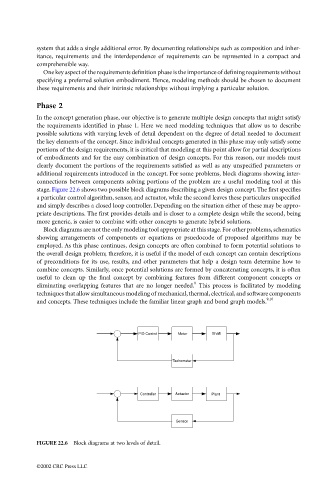
                                 additional requirements introduced in the concept. For some problems, block diagrams showing inter-
                                 connections between components solving portions of the problem are a useful modeling tool at this
                                 stage. Figure 22.6 shows two possible block diagrams describing a given design concept. The first specifies
                                 a particular control algorithm, sensor, and actuator, while the second leaves these particulars unspecified
                                 and simply describes a closed loop controller. Depending on the situation either of these may be appro-
                                 priate descriptions. The first provides details and is closer to a complete design while the second, being
                                 more generic, is easier to combine with other concepts to generate hybrid solutions.
                                   Block diagrams are not the only modeling tool appropriate at this stage. For other problems, schematics
                                 showing arrangements of components or equations or psuedocode of proposed algorithms may be
                                 employed. As this phase continues, design concepts are often combined to form potential solutions to
                                 the overall design problem; therefore, it is useful if the model of each concept can contain descriptions
                                 of preconditions for its use, results, and other parameters that help a design team determine how to
                                 combine concepts. Similarly, once potential solutions are formed by concatenating concepts, it is often
                                 useful to clean up the final concept by combining features from different component concepts or
                                                                                 8
                                 eliminating overlapping features that are no longer needed.  This process is facilitated by modeling
                                 techniques that allow simultaneous modeling of mechanical, thermal, electrical, and software components
                                 and concepts. These techniques include the familiar linear graph and bond graph models. 9,10


                                                                PID Control  Motor    Shaft


                                                                          Tachometer


                                                                Controller  Actuator  Plant


                                                                           Sensor


                                 FIGURE 22.6  Block diagrams at two levels of detail.


                                 ©2002 CRC Press LLC

