


Page 112 - Theory and Design of Air Cushion Craft
P. 112
96  Steady drag forces

                3.4  Aerodynamic profile drag


             The aerodynamic  profile  drag can be written as

                                            -  c       v                          nfi\
                                                     ^
                                          R a -
                                          A    C  — • 9 a V                      p.OJ
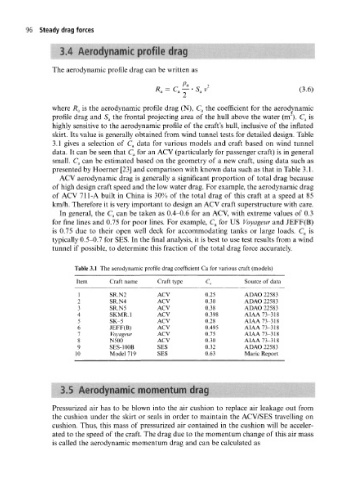
             where  7? a  is the  aerodynamic  profile  drag  (N),  C a the  coefficient  for  the  aerodynamic
                                                                               2
             profile  drag  and  S a the  frontal projecting area  of  the  hull above the water  (m ).  C a is
             highly sensitive to  the aerodynamic  profile of  the craft's hull, inclusive of  the inflated
             skirt.  Its value  is generally  obtained from wind tunnel  tests for detailed design.  Table
             3.1  gives a  selection  of  C a  data  for  various  models  and  craft  based  on  wind tunnel
             data.  It can  be seen that  C a for an  ACV (particularly for passenger craft) is in general
             small.  C a can  be estimated based  on the  geometry  of  a new craft, using data  such  as
             presented by Hoerner  [23] and comparison  with known data such as that  in Table  3.1.
               ACV aerodynamic drag  is generally a  significant  proportion  of  total  drag  because
             of  high design craft speed and the low water drag. For example, the aerodynamic  drag
             of  ACV  711-A  built  in  China  is 30% of  the  total  drag  of  this craft  at  a  speed  at  85
             km/h. Therefore it is very important  to design an ACV craft superstructure with care.
               In  general,  the  C a can  be taken  as 0.4-0.6 for  an  ACV, with extreme values of  0.3
             for  fine lines and  0.75 for poor lines. For  example,  C a for  US  Voyageur  and  JEFF(B)
             is  0.75  due  to  their  open  well  deck  for  accommodating  tanks  or  large  loads.  C a  is
             typically 0.5-0.7 for SES. In the final analysis, it is best to use test results from a wind
             tunnel if possible, to determine this fraction  of  the total drag  force  accurately.


                    Table 3.1  The aerodynamic profile drag coefficient  Ca for various craft (models)
                    Item     Craft  name  Craft  type   C,        Source of  data
                     1       SR.N2        ACV           0.25      ADAO 22583
                    2        SR.N4        ACV           0.30      ADAO 22583
                    3        SR.N5        ACV           0.38      ADAO 22583
                    4        SKMR.l       ACV           0.398     AIAA  73-318
                    5        SK-5         ACV           0.28      AIAA  73-318
                    6        JEFF(B)      ACV           0.495     AIAA 73-3 18
                    7        Voyageur     ACV           0.75      AIAA 73-3 18
                    8        N500         ACV           0.30      AIAA  73-3 18
                    9        SES-100B     SES           0.32      ADAO 22583
                    10       Model  71 9  SES           0.63      Marie Report


                3.5  Aerodynamic     momentum drag


             Pressurized  air has  to  be blown into  the  air cushion  to  replace  air  leakage  out  from
             the  cushion  under  the  skirt  or  seals in order  to maintain  the ACV/SES  travelling on
             cushion.  Thus,  this mass  of  pressurized  air  contained  in the  cushion  will be  acceler-
             ated  to the speed of the craft. The drag due to the momentum  change of  this air mass
             is called  the aerodynamic  momentum  drag  and can be calculated  as

