


Page 116 - Theory and Design of Air Cushion Craft
P. 116
100  Steady drag forces


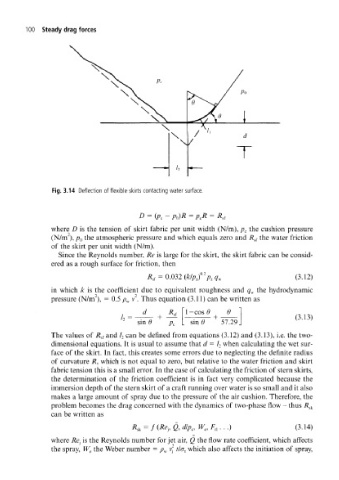
             Fig.  3.14  Deflection  of flexible  skirts contacting  water  surface.


                                        =  (p e    =  PcR  = R s
             where  D  is the  tension  of  skirt  fabric per  unit width  (N/m), p c  the  cushion  pressure
                      the  atmospheric  pressure  and  which equals zero  and  the  water friction
             (N/m"), p 0                                           R sf
             of  the skirt per unit width (N/m).
               Since the Reynolds number, Re is large for the skirt, the skirt fabric can  be consid-
             ered  as a rough  surface for friction,  then
                                         * =  0.032  (k/pf-p z                  (3.12)
             in  which  k  is the  coefficient  due  to  equivalent roughness  and  q w  the  hydrodynamic
             pressure (N/m"),  =  0.5 /? w  v". Thus equation  (3.11) can  be written as
                                                  1-cos
                                                                                (3.13)
                                     sin 0         sin 0    57.29
             The  values of  R sf  and  can  be  defined  from equations (3.12) and  (3.13), i.e. the  two-
                                1 2
             dimensional equations. It  is usual to  assume that  d  =  when calculating the wet sur-
                                                           1 2
             face  of  the skirt. In fact,  this creates  some errors  due  to neglecting the definite  radius
             of  curvature R, which is not  equal to  zero, but  relative to  the water friction and  skirt
             fabric tension this is a small error. In the case of calculating the friction of  stern skirts,
             the  determination  of  the  friction  coefficient  is in  fact  very complicated  because  the
             immersion depth  of  the stern skirt of  a craft running over water is so small and  it also
             makes a large amount of  spray  due to the pressure of  the air cushion.  Therefore,  the
             problem  becomes the drag concerned with the dynamics of two-phase flow -  thus  R^ k
             can be written as
                                             >,  Q,d/p c,                       (3.14)
             where Re } is the  Reynolds number  for jet  air,  Q the flow rate  coefficient,  which  affects
             the  spray,  W e the  Weber number  =  p w  v]  t/a {  which also  affects  the  initiation of  spray,

