


Page 118 - Theory and Design of Air Cushion Craft
P. 118
102  Steady drag forces

                                                                                (3.18a)
              where  PFis the weight of  the  craft  (N).

              Drag  of  bow/stern  seals  of  an  SES, fl sb,  R s

              This is also estimated based  on test data.  Two methods  for predicting this drag  are as
              follows.

              MARIC method     [27]
              Based  upon  a  series of  model  tests,  a statistical  analysis was carried  out  at  MARIC.
              Putting  the  skirt  (bow/stern) drag,  the  drag  due  to  the  differential  momentum  from
             the bow/stern  seals, the wave-making drag  of  sidewalls, and  the interference drag  due
              to  sidewalls, all into  a  single term  'residual drag' and  then  processing  this by regres-
              sion  analysis, the following equation  is  obtained:

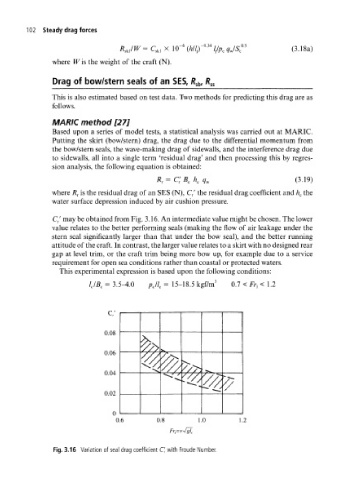
                                          R r  =  C r'                           (3.19)
             where R r is the residual drag of  an SES (N),  C/ the residual drag coefficient  and h c the
             water surface depression  induced  by air cushion  pressure.

              C/ may be obtained  from  Fig. 3.16. An intermediate value might be chosen. The lower
             value relates to  the better  performing seals (making the flow of  air leakage under  the
              stern  seal  significantly  larger  than  that  under  the  bow  seal),  and  the  better  running
             attitude of the craft. In contrast, the larger value relates to a skirt with no designed rear
             gap at  level trim,  or  the craft  trim  being  more bow up,  for example  due  to  a  service
              requirement for open sea conditions rather than coastal  or protected  waters.
                This experimental expression  is based  upon  the following  conditions:
                            = 3.5-4.0       =  15-18.5 kgf/m  3  0.7 < /r, < 1.2
                        IJB C           p cll c


                            0.08

                            0.06


                            0.04

                            0.02


                               0.6        0.8         1.0        1.2


              Fig.  3.16  Variation  of  seal  drag coefficient  C, with  Froude  Number.

