


Page 119 - Theory and Design of Air Cushion Craft
P. 119
Skirt drag  103

          Rin-lchi Marao   method   [28]
          Model experiments were carried out  on an  SES with thin plates as sidewalls and with
               = 2 approximately, by Rin-lchi and Marao. The air profile drag was then deducted
          l c/B c
          and the aerodynamic  momentum drag and wave-making drag obtained  from analysis
          of  the  measured  wave profile.  These  components  were then  deducted  from  the  total
          drag  of  models  to  obtain  the  residual  drag.  The  form  drag  of  sidewalls  can  be
          neglected due to the thin plate sidewalls used, so that the residual drag can be approx-
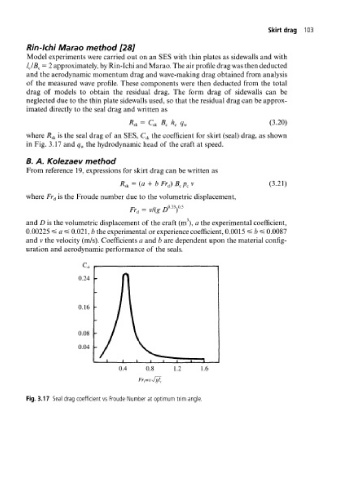
          imated  directly to  the  seal drag  and written as

                                          =                                  (3.20)
                                      # sk  C sk  B c  h c  q w
                   is the  seal drag of  an  SES,  C sk the  coefficient  for skirt (seal) drag,  as shown
          where R sk
          in Fig.  3.17 and  q w the hydrodynamic head  of  the craft  at  speed.
          B. A.  Kolezaev  method
          From reference  19, expressions for skirt drag  can  be written as
                                       = (a +  bFr d)B cPcv                  (3.21)
                                    R sk
                   is the  Froude  number  due to  the volumetric  displacement,
          where Fr d
                                       17    u  ri 0.33x0.5
                                       Fr d  =  v/(g  D
                                                      3
          and  D is the volumetric displacement  of  the craft  (m ), a the experimental  coefficient,
          0.00225  s= a ss 0.021, b the experimental or experience coefficient,  0.0015 ^ b ^ 0.0087
          and  v the velocity (m/s). Coefficients  a and  b are dependent  upon  the material  config-
          uration  and  aerodynamic performance of  the seals.


                         0.24


                         0.16


                         0.08

                         0.04

                                    0.4    0.8     1.2    1.6


          Fig.  3.17  Seal  drag coefficient vs Froude Number  at  optimum  trim  angle.

