


Page 123 - Theory and Design of Air Cushion Craft
P. 123
Sidewall  water friction drag  107


                                                     Using  flexible  bow/stern seals


              1.0 =._.


                0.2


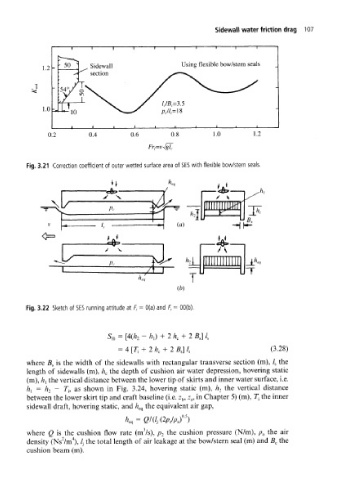
          Fig. 3.21  Correction coefficient of  outer wetted  surface  area  of  SES with flexible bow/stern seals.

                                 11              h eq
                                                                          ,h.
                                                              • ^^^* «
                   |           >  X           / *             >  X
                                                r—i
              -r-^               *          d f^
                   T
                »   L          / ts
                    r
              <F=               >  <
                                               I
                    I           ^            J
                  -V                            ^
                                                                      T
                                                       T
                                                   (b)


          Fig. 3.22  Sketch of  SES running attitude  at  F r  =  0(a) and  F r  =  00(b).


                                                   B                         (3.28)
          where  5 S is the  width  of  the  sidewalls with  rectangular  transverse  section  (m), s /  the
          length  of  sidewalls  (m),  /z c the depth of  cushion air water depression, hovering  static
          (m), /z, the vertical distance  between the lower tip of skirts and  inner water surface, i.e.
          //!  =  h 2  ~  T },  as  shown  in  Fig.  3.24,  hovering  static  (m),  H 2  the  vertical  distance
          between the lower skirt tip  and  craft  baseline (i.e. z b, z s, in Chapter  5) (m),  T { the  inner
          sidewall draft,  hovering static,  and  /z eq the  equivalent air  gap,


          where  Q  is  the  cushion  flow  rate  (m'Vs),  p 2  the  cushion  pressure  (N/m),  p a  the  air
                      4
                    2
          density (Ns /m ), } the total  length  of  air  leakage  at the  bow/stern  seal (m) and  B c  the
                         l
          cushion  beam  (m).

