


Page 128 - Theory and Design of Air Cushion Craft
P. 128
12  Steady drag forces

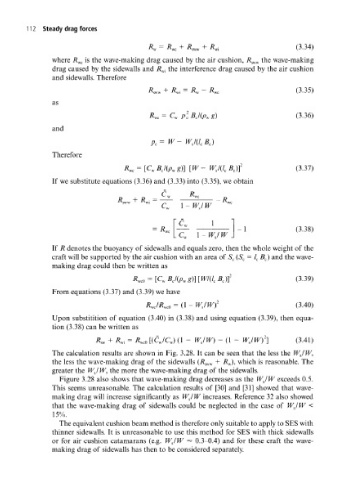
                                                                                (3.34)
                                             R wc  + R^ w  + R m
                      is the  wave-making drag  caused  by the  air  cushion,  the wave-making
             where R wc                                            R sww
             drag caused  by the  sidewalls and R m  the interference  drag  caused by the air  cushion
             and  sidewalls. Therefore

                                        ^sww  +  ^wi  =  ^w  ~~  ^wc            (3.35)
             as
                                                  2
                                                 p cBJ^g)                       (3.36)
                                        R WC=C W
             and
                                        Pc=W-      WJ(1 CB C)
             Therefore
                                     =          g)][W-        B c)f             (3.37)
                                 * wc  [C w BJ(p w       WJ(l c
             If  we substitute equations  (3.36) and  (3.33) into  (3.35), we obtain
                                           /->     n
                                R sww  +  K W1  =  '      -  R wc
                                           c     \-wjw

                                                         1
                                                                -  1            (3.38)
                                                C,    \-WJW
             If  R  denotes  the buoyancy of  sidewalls and  equals zero, then the whole weight of  the
             craft  will be supported  by the air cushion with an area  of  S c (S c  =  1 CB C) and  the wave-
             making  drag  could  then be written as

                                   * Wco  =  [C w BJfa  g)}  [W/(l c  B e)      (3.39)
             From equations  (3.37) and  (3.39) we have
                                       *wc/* wco = (1 -  WJW} 2                 (3.40)
             Upon  substitition  of  equation  (3.40) in  (3.38) and  using equation  (3.39),  then  equa-
             tion  (3.38) can be written as
                                                                       2
                         7? sw + R^  = * WCO [(C W/C W) (1 -  WJW)  -  (1 -  WJW} }  (3.41)
             The calculation  results are  shown in Fig.  3.28. It  can be seen that  the  less the  WJW,
             the less the wave-making drag  of  the sidewalls (R,^  + ^ w), which is reasonable.  The
             greater  the  WJW,  the more  the wave-making drag of  the sidewalls.
               Figure  3.28 also  shows that  wave-making drag  decreases  as the  WJW  exceeds  0.5.
             This  seems  unreasonable.  The  calculation  results of  [30] and  [31]  showed  that  wave-
             making drag will increase  significantly as  WJW  increases.  Reference  32 also  showed
             that  the  wave-making  drag  of  sidewalls  could  be  neglected  in  the  case  of  WJW  <
             15%.
               The equivalent cushion beam method  is therefore only suitable to apply to SES with
             thinner  sidewalls. It  is unreasonable  to  use this method  for  SES with  thick  sidewalls
             or  for  air  cushion  catamarans  (e.g.  WJW  ~  0.3-0.4)  and  for  these  craft  the  wave-
             making drag of  sidewalls has then  to be considered  separately.

