


Page 129 - Theory and Design of Air Cushion Craft
P. 129
Sidewall wave-making drag  113

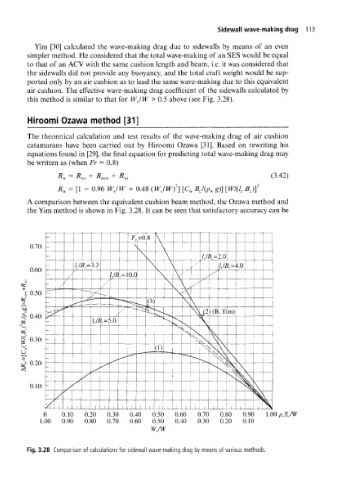
            Yim  [30] calculated  the  wave-making  drag  due  to  sidewalls  by  means  of  an  even
          simpler method.  He considered  that the total wave-making of  an SES would be equal
          to that  of  an ACV with the same cushion length and  beam, i.e. it was considered  that
          the  sidewalls did not  provide any buoyancy, and  the total  craft weight would be  sup-
          ported  only by an air cushion  as to lead the same wave-making due to this equivalent
          air cushion. The  effective  wave-making drag  coefficient  of  the  sidewalls calculated  by
          this method  is similar to that for  WJW  > 0.5 above  (see Fig.  3.28).

          Hiroomi   Ozawa method [31]

          The  theoretical calculation  and  test  results of  the  wave-making drag  of  air  cushion
          catamarans  have  been  carried  out  by  Hiroomi  Ozawa  [31].  Based  on  rewriting  his
          equations found in [29], the final equation  for predicting total wave-making drag may
          be written as (when Fr  = 0.8)
                   R», — R,,,,  +  R c  +                                    (3.42)
                                                  2
                    V  = [1 -  0.96  WJW  + 0.48 (WJW) }  [C w B c/(p v  gj\  [Wl(l c  B c)] :
          A comparison  between the equivalent cushion beam method, the Ozawa method  and
          the Yim method  is shown in Fig.  3.28. It can be seen that satisfactory accuracy can be


           0.70  -


               0    0.10  0.20  0.30   0.40  0.50  0.60  0.70  0.80   0.90  1.00  p cS c/W
              1.00  0.90  0.80  0.70  0.60   0.50  0.40  0.30  0.20   0.10
                                            WJW


          Fig.  3.28  Comparison  of calculations  for  sidewall  wave-making  drag  by means  of various  methods.

