


Page 130 - Theory and Design of Air Cushion Craft
P. 130
114  Steady drag forces

             obtained  by the  equivalent  method  in the  case  of  WJW  < 0.2, but  the  wave-making
             drag of  sidewalls and  its interference drag  with the air cushion  have to  be taken  into
             account  as  WJW  increases.
               In conclusion,  the methods  for estimating  sidewall drag introduced  here are suitable
             for  SES with  sidewall  displacement  up  to  about  30% of  craft  total  weight.  Where  a
             larger  proportion  of  craft  weight is borne  by the  sidewalls, the  sidehull wave-making
             should  be  considered  directly,  rather  than  as  a  'correction'  to  the  cushion  wave-
             making. Below 70% contribution  to support  from  the air cushion,  the beneficial  effect
             of  the  cushion  itself  rapidly  dies  away, and  so it  is more  likely that  optimizing  cata-
             maran  hulls  will achieve  the  designer's  requirements  in the  speed  range  to  40  knots.
             Above  this speed,  an air cushion  supporting  most  of  the craft weight is most  likely to
             give the optimum  design  with minimum  powering.

             Calculation  method for   parabola-shaped    sidewalls [33]

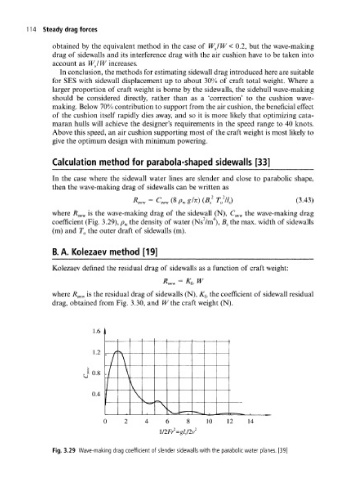
             In  the  case  where  the  sidewall water  lines  are  slender  and  close  to  parabolic  shape,
             then  the wave-making drag  of  sidewalls can  be written as
                                              (8 Av gin)  (B s  T 0 // s)       (3.43)
             where R^  is the wave-making  drag  of  the  sidewall  (N),  C sww the wave-making  drag
             coefficient  (Fig.  3.29), p w  the density of  water  (Ns"/m  ), B s the max. width  of  sidewalls
             (m) and  T 0 the  outer  draft  of  sidewalls (m).


             B. A.  Kolezaev  method [19]

             Kolezaev  defined the residual drag  of  sidewalls as a function of  craft weight:


             where R^ is the residual drag  of  sidewalls (N),  K fr  the coefficient  of  sidewall  residual
             drag,  obtained  from Fig.  3.30, and  IV the craft  weight  (N).


                         1.6


                                                        10   12    14
                                               2
                                           l/2Fr =g/ s/2v 2
             Fig. 3.29  Wave-making drag coefficient  of slender  sidewalls with the  parabolic water  planes. [39]

