


Page 135 - Theory and Design of Air Cushion Craft
P. 135
Total ACV  and SES drag over water  119

                                                              X9.8N


                                                              16000

                                                              14000

                                                              12000


                                                              10000

                                                              8000

                                                              6000

                                                              4000


                                                              2000
                              20  40  60  80  100 120 140  v(km/h)
                                20    40    60    80  v(kn)

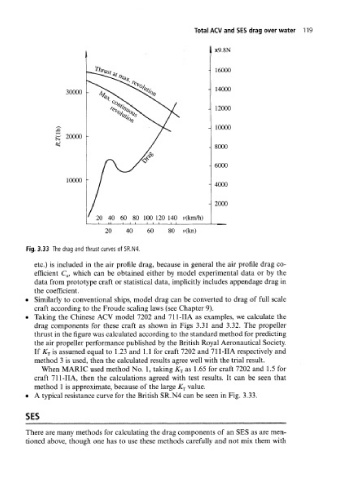
          Fig. 3.33  The drag and thrust curves  of  SR.N4.

             etc.) is included  in the  air  profile  drag,  because  in  general  the  air  profile  drag  co-
             efficient  C a, which  can  be  obtained  either  by  model  experimental  data  or  by  the
             data from  prototype  craft  or statistical data, implicitly includes appendage  drag in
             the  coefficient.
          •  Similarly to conventional  ships, model drag  can be converted to drag of  full  scale
             craft  according to the Froude scaling laws (see Chapter 9).
          •  Taking  the  Chinese  ACV model  7202 and  711-11A  as examples, we calculate  the
             drag  components  for  these  craft  as  shown  in  Figs  3.31  and  3.32.  The  propeller
             thrust in the figure was calculated  according to the standard  method  for predicting
             the air propeller performance published by the British Royal Aeronautical  Society.
             If  K T  is assumed  equal to  1.23 and  1.1 for craft  7202 and  711-IIA respectively and
             method  3 is used,  then  the calculated  results agree well with the trial result.
              When  MARIC used method  No.  1, taking K 7  as  1.65 for craft  7202 and  1.5 for
             craft  711-IIA,  then  the  calculations  agreed  with  test  results.  It  can  be  seen  that
             method  1 is approximate,  because  of  the  large K^ value.
          •  A typical resistance curve for the British SR.N4  can be seen in Fig. 3.33.

          SES

          There  are many methods  for calculating the drag components  of  an  SES as are men-
          tioned  above,  though one has to  use these  methods carefully  and  not  mix them  with

