


Page 139 - Theory and Design of Air Cushion Craft
P. 139
122  Steady drag forces

             is a high percentage of  the total  drag. The total overland drag of ACV can be written
             as  follows:

                                  ^gacv  =  ^a +  ^m +  ^sp  +  ^si +  ^sk      (3.50)
             where  R gacv  is the  total  overland  drag  of  ACV (N),  R a  the  aerodynamic  profile  drag
              (N), R m the aerodynamic momentum  drag (N), R sp the spray (debris) momentum  drag
             (N),  R si the slope drag  (N) and  R sk  the skirt/terrain interaction  drag  (N).
               R a,  R m  can  be  calculated  by  the  methods  outlined  above.  R sp  can  usually  be
             neglected due to  the craft's low speed.  The  slope drag  can be calculated  according  to
             the geography of  the terrain.  The skirt/terrain interaction  drag is very strongly sensi-
             tive to  lift  air flow and  is a function of  craft  speed and  terrain condition.  It is  difficult
             to determine analytically and  is usually determined from  experimental data.
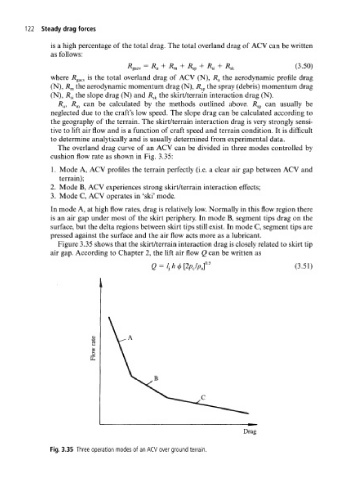
               The  overland  drag  curve  of  an  ACV can  be divided  in three modes  controlled  by
             cushion flow rate as shown in Fig. 3.35:

              1.  Mode  A,  ACV profiles  the  terrain  perfectly  (i.e. a clear  air  gap  between  ACV  and
                terrain);
             2.  Mode  B, ACV experiences strong skirt/terrain  interaction  effects;
             3.  Mode C, ACV operates in 'ski'  mode.

             In mode A, at high flow rates, drag is relatively low. Normally in this flow region there
             is an  air gap under most  of  the  skirt periphery. In mode  B, segment tips drag  on  the
             surface,  but the delta regions between skirt tips still exist. In mode  C, segment tips are
             pressed  against the surface and the air flow acts more as a lubricant.
               Figure 3.35 shows that the skirt/terrain interaction drag is closely related to skirt tip
             air  gap. According to Chapter  2, the  lift  air flow Q can  be written as
                                                        0.5
                                             l
                                         Q  = ih<j>  [2p c/pJ                   (3.51)


                                                                  Drag

             Fig.  3.35  Three operation  modes  of  an ACV over ground  terrain.

