


Page 140 - Theory and Design of Air Cushion Craft
P. 140
Skirt/terrain  interaction drag  123

          where  Q is the  lift  air  flow  (m  ),  /_,  the  peripheral  length  of  the  skirts (m),  h the  skirt
          clearance,  including the equivalent clearance  regarding the air leakage from the  delta
          area of  fingers,  </> the  air flow discharge coefficient  and/? c the  cushion pressure (N/m~).
            Different  terrain conditions can radically change the effective  discharge  coefficient,
          (see  Table  3.5). Grass or  rock  have the  greatest  effect.  It  is inappropriate  therefore  to
          characterize  the  air  gap by h alone,  since rough  terrain  and  stiff  grasses  or  reeds will
          reduce  the skirt clearance  significantly  at the same air flow.
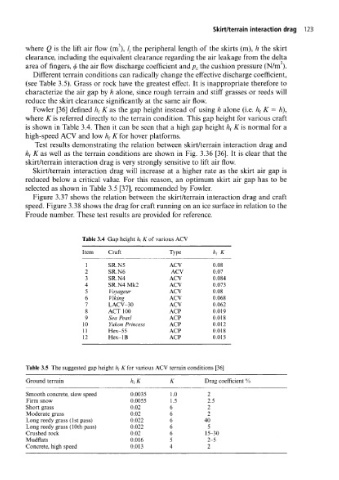
            Fowler  [36] defined  h { K  as  the  gap  height  instead  of  using h alone  (i.e.  h f  K  =  h),
          where K is referred directly to  the terrain condition.  This gap height for various  craft
          is shown  in Table  3.4. Then  it can  be  seen that  a high gap  height  K is normal  for a
                                                                 h {
          high-speed  ACV  and  low  h f  K  for  hover platforms.
             Test  results demonstrating  the  relation between  skirt/terrain interaction  drag  and
            K  as  well  as  the  terrain  conditions  are  shown  in  Fig.  3.36  [36].  It  is clear  that  the
          h f
          skirt/terrain interaction  drag is very strongly sensitive to  lift  air flow.
            Skirt/terrain  interaction  drag  will  increase  at  a  higher  rate  as  the  skirt  air  gap  is
          reduced  below  a  critical value. For  this  reason,  an  optimum  skirt  air  gap  has  to  be
          selected  as shown in Table  3.5  [37], recommended  by  Fowler.
            Figure  3.37 shows the  relation  between  the  skirt/terrain interaction  drag  and  craft
          speed.  Figure  3.38 shows the drag for craft  running on an ice surface in relation to  the
          Froude number.  These  test results are provided  for reference.


                         Table 3.4  Gap  height h ( K of various ACV
                          Item   Craft           Type        h f  K
                          1      SR.N5           ACV         0.08
                          2      SR.N6            ACV        0.07
                          3      SR.N4           ACV         0.084
                          4      SR.N4 Mk2       ACV         0.073
                          5      Voyageur        ACV         0.08
                          6      Viking          ACV         0.068
                          7      LACV-30         ACV         0.062
                          8      ACT  100        ACP         0.019
                          9      Sea  Pearl      ACP         0.018
                          10     Yukon Princess  ACP         0.012
                          11     Hex-55          ACP         0.018
                          12     Hex- IB         ACP         0.015


          Table 3.5  The  suggested gap height  K for various ACV terrain conditions [36]
                                   h {
          Ground  terrain              h { K      K        Drag coefficient  %

          Smooth concrete, slow speed  0.0035     1.0       2
          Firm snow                    0.0055     1.5       2.5
          Short grass                  0.02       6         2
          Moderate grass               0.02       6         2
          Long reedy grass (1st pass)  0.022      6        40
          Long reedy grass (10th pass)  0.022     6         5
          Crushed  rock                0.02       6        15-30
          Mudflats                     0.016      5         2-5
          Concrete,  high speed        0.013     4          2

