


Page 142 - Theory and Design of Air Cushion Craft
P. 142
Problems concerning ACV/SES  take-off  125

                        (RJW)
                   0.06
                            o Boeing Corporation
                            n Bell Textron   Regressive curve
                            A Aerojet General
                   0.04


                   0.02


                                                                    4  Fr

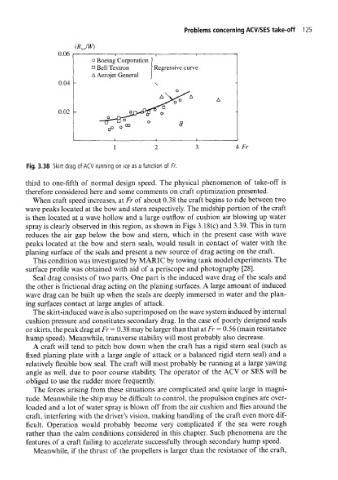
          Fig.  3.38  Skirt  drag of ACV running  on  ice as a function  of Fr.

          third  to  one-fifth  of  normal  design  speed.  The  physical phenomenon  of  take-off  is
          therefore  considered  here and  some comments on craft optimization  presented.
            When craft  speed increases, at Fr of  about  0.38 the craft begins to ride between two
          wave peaks located  at the bow and  stern respectively. The midship portion  of the  craft
          is then located at a wave hollow and  a large  outflow of  cushion air  blowing up  water
          spray is clearly observed in this region, as shown in Figs 3.18(c) and  3.39. This in turn
          reduces  the  air  gap  below  the  bow  and  stern,  which  in  the  present  case  with wave
          peaks  located  at  the  bow  and  stern  seals,  would  result in  contact  of  water with  the
          planing surface of  the  seals and  present a new source of  drag acting on the  craft.
            This condition was investigated by MARIC by towing tank model experiments. The
          surface  profile  was obtained with aid  of  a periscope and  photography  [28].
            Seal drag consists of  two parts. One part is the induced wave drag  of  the  seals  and
          the other is frictional drag acting on the planing surfaces. A large amount  of  induced
          wave drag can  be built  up when the  seals are deeply immersed  in water and  the  plan-
          ing surfaces contact  at large angles of  attack.
            The skirt-induced wave is also superimposed on the wave system induced by internal
          cushion  pressure and constitutes secondary drag. In the case of poorly designed seals
          or skirts, the peak drag at Fr = 0.38 may be larger than that at Fr = 0.56 (main resistance
          hump  speed). Meanwhile, transverse  stability will most probably also decrease.
            A craft will  tend  to  pitch  bow  down when  the  craft  has  a rigid stern  seal  (such  as
          fixed planing plate with a large  angle  of  attack  or  a balanced  rigid stern  seal)  and  a
          relatively flexible  bow seal. The  craft  will most  probably  be running at a large yawing
          angle  as  well,  due  to  poor  course  stability. The  operator  of  the  ACV  or  SES will  be
          obliged to use the rudder more  frequently.
            The  forces  arising from  these situations are complicated and  quite large in magni-
          tude. Meanwhile the ship may be difficult  to control, the propulsion  engines are over-
          loaded  and  a lot of water spray is blown off from  the air cushion and flies around  the
          craft,  interfering with the driver's  vision, making handling  of  the craft  even more dif-
          ficult.  Operation  would  probably  become  very  complicated  if  the  sea  were  rough
          rather  than  the  calm  conditions  considered  in this chapter.  Such phenomena  are  the
          features  of  a craft  failing  to  accelerate successfully through secondary hump  speed.
            Meanwhile, if the thrust of  the propellers is larger than the  resistance of  the craft,

