


Page 147 - Theory and Design of Air Cushion Craft
P. 147
130  Steady  drag forces

                3.15  Effect  of  various factors  on drag


             The themes to be discussed here are the problems related to the drag of craft  running
             over calm water. The performance on rough  sea will be discussed in Chapter  8. Since
             the  hovercraft, especially ACVs,  travels close  to  the  water  surface at  high  speed,  the
             drag will increase dramatically as soon  as the skirts come  into contact  with the water
             surface occasionally making the drag unstable in magnitude. The effect  of various fac-
             tors  on the craft  performance are as  follows.

             The  effect  of  position  of LCG

             The  effect  of  LCG  on craft  drag,  mainly skirt drag,  is deterministic. A  slight  change
             of  LCG  will lead directly to varying craft  drag due to its effect  on bow and  stern skirt
             friction,  especially in the  case  of  poorly designed bow/stern skirts.
               With  respect  to  SES,  especially  SES with thin  sidewalls, the  change  of  LCG  will
             also  lead  to  a draft change at bow/stern  seals, increasing seal drag,  in the  case  of  no
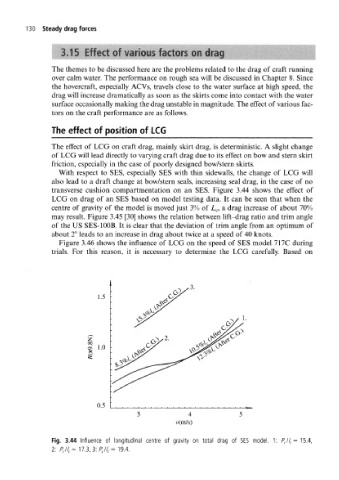
             transverse  cushion  compartmentation  on  an  SES.  Figure  3.44  shows  the  effect  of
             LCG  on  drag  of  an  SES based  on  model  testing data.  It  can  be  seen that  when  the
             centre  of  gravity of  the  model  is moved just  3% of  L c, a drag  increase  of  about  70%
             may result. Figure  3.45 [30] shows the relation between lift-drag  ratio  and  trim angle
             of  the US  SES-100B. It  is clear that  the deviation of  trim angle from  an  optimum  of
             about  2° leads to  an  increase in drag about  twice at a speed  of  40 knots.
               Figure  3.46 shows the  influence  of  LCG  on  the  speed  of  SES model  717C during
             trials.  For  this  reason,  it  is  necessary  to  determine  the  LCG  carefully.  Based  on


                          1.5


                       oo
                       cK  1.0
                       X


                          0.5
                                                   4
                                               v(m/s)

             Fig.  3.44  Influence  of  longitudinal  centre  of  gravity  on  total  drag  of  SES model.  1:  P cll c =  15.4,
             2:  P cll c=  17.3,3:^/4= 19.4.

