


Page 151 - Theory and Design of Air Cushion Craft
P. 151
134  Steady drag forces

                         30                     G, =0.00205  03=0.00615
                                                £> 2=0.0041


                       §20


                                        0.5             1.0       Fr

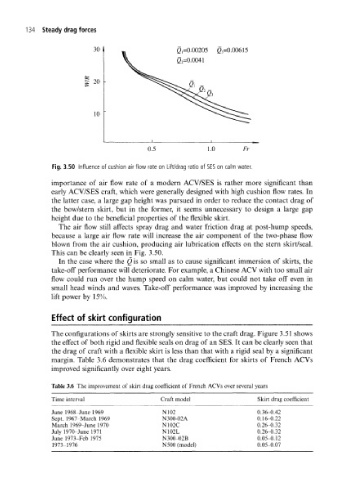
              Fig. 3.50  Influence  of  cushion  air flow  rate on  Lift/drag  ratio of  SES on calm water.

              importance  of  air flow rate  of  a  modern  ACV/SES  is rather  more  significant  than
              early ACV/SES  craft, which were generally designed  with high cushion flow rates.  In
              the latter  case,  a large gap height  was pursued  in order  to  reduce  the contact  drag  of
              the  bow/stern  skirt,  but  in  the  former,  it  seems  unnecessary  to  design  a  large  gap
              height due to the beneficial properties  of  the flexible skirt.
                The  air flow  still  affects  spray  drag  and  water  friction  drag  at  post-hump  speeds,
              because  a  large  air flow rate  will  increase  the  air  component  of  the  two-phase  flow
              blown  from  the  air  cushion,  producing  air  lubrication  effects  on  the  stern  skirt/seal.
              This  can  be clearly seen in Fig.  3.50.
                In  the  case  where the  Q is so small  as to  cause  significant immersion  of  skirts,  the
              take-off  performance  will deteriorate.  For example, a Chinese ACV with too  small air
              flow could  run  over  the  hump  speed  on  calm  water,  but  could  not  take  off  even  in
              small  head  winds  and  waves. Take-off  performance  was improved  by  increasing  the
              lift  power  by  15%.

              Effect  of  skirt configuration

              The configurations of  skirts are strongly sensitive to the craft drag.  Figure  3.51 shows
              the  effect  of both  rigid and flexible seals on drag of  an  SES. It can be clearly seen that
              the drag  of  craft  with a flexible skirt is less than that with a rigid  seal by a significant
              margin.  Table  3.6 demonstrates  that  the  drag  coefficient  for  skirts  of  French  ACVs
              improved  significantly  over eight years.

              Table 3.6  The improvement of  skirt drag coefficient  of  French ACVs over several years
              Time interval                 Craft  model              Skirt drag  coefficient
              June  1968-June 1969          N102                      0.36-0.42
              Sept.  1967-March 1969        N300-02A                  0.16-0.22
              March  1969-June 1970         N102C                     0.26-0.32
              July  1970-June 1971          N102L                     0.26-0.32
              June  1973-Feb 1975           N300-02B                  0.05-0.12
              1973-1976                     N500 (model)              0.05-0.07

