


Page 155 - Theory and Design of Air Cushion Craft
P. 155
138  Stability


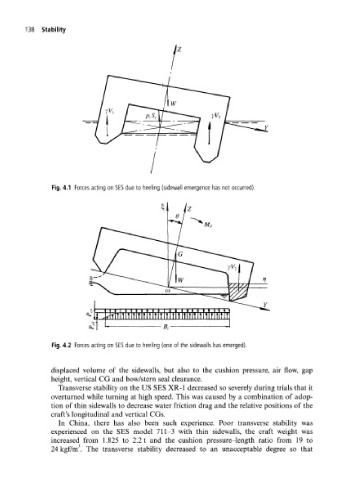
              Fig.  4.1  Forces acting  on SES  due to  heeling  (sidewall  emergence has not occurred).


                       0,  I ' £T t I1It 1 1 t 1 It 1 t I1 ! !If 1 1
                         H
                        =C   ..              Ti               -

              Fig.  4.2  Forces  acting  on  SES due to  heeling (one  of  the  sidewalls  has emerged).


              displaced  volume  of  the  sidewalls,  but  also  to  the  cushion  pressure,  air  flow,  gap
              height, vertical CG  and  bow/stern  seal  clearance.
                Transverse  stability on the US SES XR-1 decreased  so severely during trials that  it
              overturned  while turning  at high  speed.  This  was caused  by a combination  of  adop-
              tion  of  thin  sidewalls to  decrease  water friction  drag  and  the relative positions  of  the
              craft's  longitudinal and  vertical  CGs.
                In  China,  there  has  also  been  such  experience.  Poor  transverse  stability  was
              experienced  on  the  SES  model  711-3  with  thin  sidewalls,  the  craft  weight  was
              increased  from  1.825  to  2.2 t  and  the  cushion  pressure-length  ratio  from  19  to
              24 kgf/m  .  The  transverse  stability  decreased  to  an  unacceptable  degree  so  that

