


Page 160 - Theory and Design of Air Cushion Craft
P. 160
Static transverse stability of  SES on  cushion  143


                                            Input data
                      Craft  parameters, sidewall dimensions and offsets,  lift  fan characteristics
                                                T

                                       Series  of heeling angles
                                               I

                                     Series  of inner sidewall drafts { t
                 Option 1                                                 Option 2

                    Find corresponding  area                Find cushion pressure
                     of air leakage A^,  A J2              from  weight equation, p c


                   Find corresponding  cushion pressure
                        from  the energy equation


                               Find general  solution of equations (4.8 and 4.9)
                       i.e. the cushion pressure p c and equilibrium inner draft  of sidewalls t


                              Determine restoring moment M fl at heeling angle 6


                                       Restoring moment curve


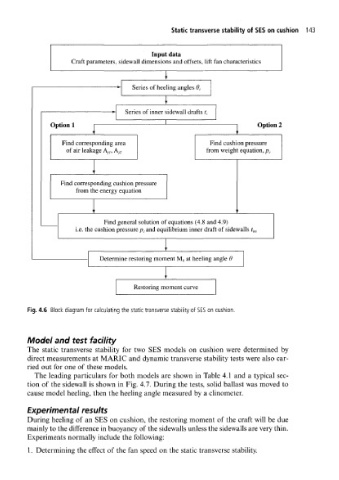
          Fig.  4.6  Block  diagram  for  calculating  the  static transverse stability  of  SES on  cushion.


          Model   and  test  facility
          The  static  transverse  stability  for  two  SES  models  on  cushion  were  determined  by
          direct  measurements  at MARIC and dynamic transverse stability tests  were also  car-
          ried  out  for one  of  these  models.
            The  leading  particulars  for both models  are  shown  in  Table  4.1  and  a  typical  sec-
          tion  of  the  sidewall is shown in Fig.  4.7. During the  tests,  solid ballast  was moved  to
          cause  model  heeling, then the heeling angle measured  by a  clinometer.

          Experimental   results
          During heeling of  an  SES on  cushion,  the  restoring moment  of  the craft  will  be due
          mainly to the difference  in buoyancy  of the sidewalls unless the sidewalls are very thin.
          Experiments  normally  include the  following:
          1.  Determining  the  effect  of  the  fan  speed  on  the  static transverse stability.

