


Page 165 - Theory and Design of Air Cushion Craft
P. 165
148  Stability

             Table 4.3  The variable range of  a,  B
             a(°)      45      45     50      50     55    55      60    60      60
             B(m)       0.16    0.18   0.16   0.18    0.16  0.18   0.16   0.18   0.20
                        0.166   0.171  0.146  0.152   0.13  0.135  0.115  0.121  0.126
             BJB e

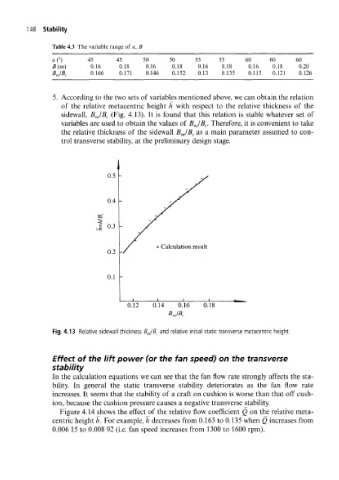
              5.  According to  the two sets of variables mentioned  above, we can obtain  the  relation
                of  the  relative  metacentric  height  h  with  respect  to  the  relative  thickness  of  the
                sidewall,  BJB C  (Fig.  4.13).  It  is found  that  this  relation  is stable  whatever  set  of
                variables are used to obtain  the values of BJB C.  Therefore, it is convenient to  take
                the  relative thickness  of  the  sidewall  B SW/B C  as  a main parameter  assumed  to  con-
                trol transverse  stability, at the preliminary  design  stage.


                             0.5  -


                             0.4


                             0.3

                                           Calculation result
                             0.2


                             0.1


                                  0.12   0.14   0.16   0.18
                                             BJB C

              Fig.  4.13  Relative sidewall  thickness  BJB C  and relative  initial  static  transverse  metacentric  height.


             Effect  of  the  lift  power  (or  the  fan  speed)  on  the  transverse
             stability
             In  the calculation  equations  we can  see that  the fan flow rate strongly  affects  the  sta-
             bility.  In  general  the  static  transverse  stability  deteriorates  as  the  fan  flow  rate
             increases. It  seems that  the stability of  a craft  on cushion  is worse than  that  off cush-
             ion,  because  the cushion  pressure  causes  a negative transverse ^ability.
                Figure 4.14 ^hows the effectj)f  the  relative flow coefficient  Q on  the  relative  meta-
             centric height h.  For example, h decreases  from  0.163 to 0.135 when  Q increases  from
             0.006  15 to  0.008  92 (i.e. fan  speed  increases from  1300 to  1600 rpm).

