


Page 170 - Theory and Design of Air Cushion Craft
P. 170
SES transverse  dynamic stability  153

          Calculation  of  craft trim

          According  to  the  method  in  Chapter  5, we can  determine  the  craft  trim  at  various
          speeds  based  on  four  relationships  from equation  (5.12) and  the other  two  equations
          (5.13, 5.14) due to the deformation of the water surface caused by wave-making of  the
          craft.  This method  is rather complicated,  especially for the calculation  of  deformation
          of  the  water  surface.  We recommend  the  use  of  a  simplified  method  for  estimating
          craft  trim and  for calculating the  forces acting on  the craft  as  follows:

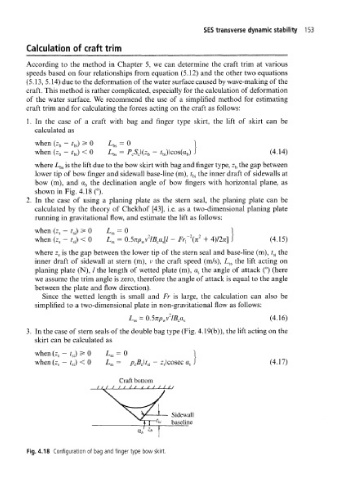
          1.  In  the  case  of  a  craft  with  bag  and  finger  type  skirt,  the  lift  of  skirt  can  be
             calculated  as
             when  (z b -  r bl) ^0  L bs  =  Q         ]
             when  (z b -  t hi)  < 0  L bs = P cS cl(z b -  f bi)lcos(a b)  J  (4.14)
             where L bs is the lift due to the bow skirt with bag and finger type, z b the gap between
             lower tip of bow finger and  sidewall  base-line  (m), t bi the inner draft  of  sidewalls  at
             bow  (m),  and  a b  the  declination  angle  of  bow  fingers  with  horizontal  plane,  as
             shown  in  Fig.  4.18 (°).
          2.  In  the  case  of  using  a  planing  plate  as  the  stern  seal,  the  planing  plate  can  be
             calculated  by  the  theory  of  Chekhof  [43], i.e. as a  two-dimensional planing  plate
             running in gravitational flow, and  estimate the  lift  as  follows:
             when  (z s -  f si) ^ 0  L ss = 0                    }
                                           2
             when  (z s -  f si) <  0  L ss =  Q.5np wv lB ca,[l  -  Fr\  \n  + 4)/2n]  J  (4.15)
             where z s is the  gap  between the  lower tip  of  the  stern  seal  and  base-line  (m),  f si  the
             inner  draft  of  sidewall at  stern  (m),  v the  craft  speed  (m/s),  L ss  the  lift  acting  on
             planing  plate  (N),  / the length  of  wetted plate  (m), a s the  angle of  attack  (°) (here
             we assume the trim angle is zero, therefore the angle of  attack  is equal to  the  angle
             between the plate  and flow direction).
               Since  the  wetted  length  is  small  and  Fr  is  large,  the  calculation  can  also  be
             simplified  to  a two-dimensional plate in non-gravitational flow as  follows:
                                                 2
                                      L ss = Q.5np wv lB ca s                (4.16)
          3.  In the case of stern seals of  the double bag type (Fig. 4.19(b)), the lift  acting on  the
             skirt can be calculated  as
             when (z s -; sl ) =*0  L ss  =  0          1
             when(z s  — f si)  <  0  L ss  =  p cB c\t si  -  z slcosec a s J  (4.17)

                                    Craft bottom


                                                  Sidewall
                                                  baseline


          Fig. 4.18  Configuration  of  bag and finger  type  bow  skirt.

