


Page 173 - Theory and Design of Air Cushion Craft
P. 173
156  Stability


                                             Input data
                                        Craft principal dimensions
                                        Sidewall offsets,  LCG, VCG
                                       Bow and stern  seal dimensions


                                    Generate  thrust and resistance curves
                                           V,,  V 2, V 3,
                                       V i=              V n
                                       R T =  R Jt, /? T2,  /? T3  .V Tn
                                       T=  T t, T 2, T 3  T n
                                   also trim moments M R and M R about VCG


                             At speed  V, assume a series of inner bow and stern drafts t hi, t s,


                     Calculate  air leakage area  Determine sidewall buoyancy and restoring moments
                     for various inner drafts  Determine cushion forces and moments
                                               Define forces acting on the seals


                                      Solve the following  relationships:
                                       (iterate to equilibrium)
                                             [t b,,t ho,  r,,,  t sa, ]
                                       W=f L           Pc
                                                  t
                                       Q=f   [tu, t bo, si,  t so, ]
                                                      Pc
                                       PC  =f  [Q]
                                              [t bi,t bo,  t si,  t so,  p c]
                                       M=f w

                                  Output  data -  for dynamic  equilibrium  at V,
                                        Cushion pressure, flow  rate,
                                  inner and outer drafts at craft  bow  and stern,
                                       true and apparent trim angles


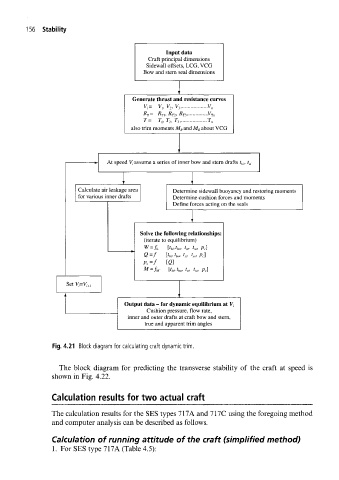
              Fig. 4.21  Block  diagram for  calculating craft  dynamic trim.


                The  block  diagram  for  predicting  the  transverse  stability  of  the  craft  at  speed  is
              shown  in Fig. 4.22.


              Calculation  results for  two  actual craft

              The calculation results  for the SES types 717A and  717C using the foregoing  method
              and computer  analysis  can be described  as follows.

              Calculation  of  running  attitude  of  the  craft  (simplified  method)
              1.  For  SES type 717A  (Table 4.5):

