


Page 172 - Theory and Design of Air Cushion Craft
P. 172
SES transverse dynamic stability  155

                               Bcl2
                        AM =      p c\y tan 0 -  (z b  -  t^]
                              J  (_- b -  / bl)cot 0
                                                              3
                                              3
                            =  1/3 p cc sca b  tan 0 [B J8  -  (z b -  t b[) 3  cot  8]
                              -  Q.5 Pcc Ka b(z b  -  -  (z b -  cotfl]      (4.18)
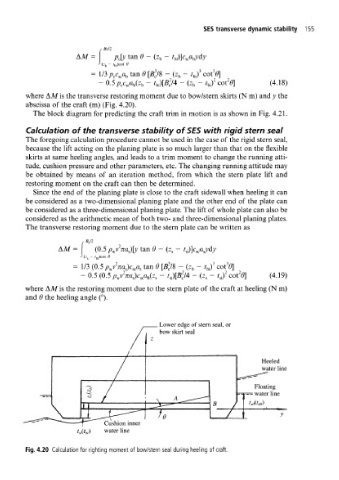
          where AM is the transverse restoring moment due to bow/stern skirts (N m) and y  the
          abscissa  of  the craft  (m) (Fig. 4.20).
            The  block diagram  for predicting the craft  trim in motion  is as shown in Fig. 4.21.

          Calculation  of  the  transverse stability  of  SES with  rigid stern seal
          The foregoing calculation procedure cannot be used in the case of  the rigid stern seal,
          because  the  lift  acting on the planing plate is so much larger than that on  the flexible
          skirts at same heeling angles, and  leads to  a trim moment to change the running atti-
          tude, cushion pressure and other  parameters, etc. The changing running attitude may
          be  obtained  by  means  of  an  iteration  method,  from  which  the  stern  plate  lift  and
          restoring moment on the craft  can then be determined.
            Since the  end  of  the planing plate  is close to  the  craft  sidewall when heeling it can
          be considered  as a two-dimensional planing plate  and  the  other  end of  the plate  can
          be considered as a three-dimensional planing plate. The lift  of whole plate can also be
          considered as the arithmetic mean  of both two- and three-dimensional planing plates.
          The transverse restoring moment  due to the stern plate can be written as

                         ^BJ2      2
                   AM =      (0.5 p wv na s)[y  tan 0 -  (z s  -  t s[)]c sca,ydy
                         J (r s -  / si)cot 6
                                                  3
                                                                  3
                                    2
                       =  1/3  (0.5 /? wv 7ra s)c sca s tan 0 [£ c /8 -  (z b -  f bl) 3  cot 0]
                         -  0.5  (0.5  Pw                                    (4.19)
          where AM is the restoring moment  due to the stern plate of  the craft  at heeling (N m)
          and  9 the heeling angle  (°).


                                               Lower edge of stern  seal, or
                                               bow skirt  seal


                                                                           Heeled
                                                                           water  line


          Fig. 4.20  Calculation for  righting  moment  of  bow/stern seal during  heeling of craft.

