


Page 166 - Theory and Design of Air Cushion Craft
P. 166
Static transverse stability  of  SES on cushion  149

                              h=h/B c

                            0.2


                            0.1


                                 0.005  0.006  0.007  0.008  Q

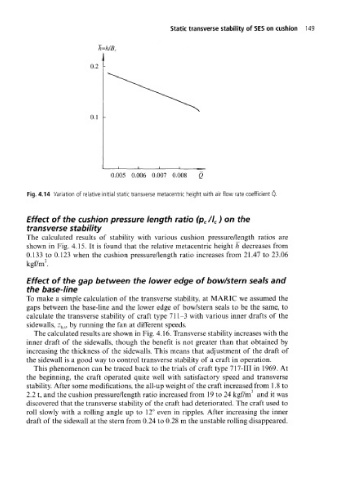
          Fig.  4.14  Variation of  relative initial  static transverse metacentric height with air flow  rate coefficient Q.


          Effect  of  the  cushion pressure length  ratio  (p c /l c)  on  the
          transverse  stability
          The  calculated  results  of  stability  with  various  cushion  pressure/length  ratios  are
          shown  in  Fig.  4.15.  It  is found that  the  relative metacentric  height  h  decreases  from
          0.133  to  0.123 when  the  cushion  pressure/length  ratio  increases  from  21.47  to  23.06
               2
          kgf/m .
          Effect  of  the  gap  between  the lower  edge  of  bow/stern  seals  and
          the  base-line
          To make  a simple  calculation  of  the  transverse  stability, at MARIC we assumed  the
          gaps  between  the  base-line  and  the  lower edge  of  bow/stern  seals  to  be the  same,  to
          calculate  the  transverse  stability of  craft  type  711-3 with various inner drafts  of  the
          sidewalls, z bs, by running the fan  at  different  speeds.
            The calculated  results are shown in Fig. 4.16. Transverse stability increases with the
          inner  draft  of  the  sidewalls,  though  the  benefit is not  greater  than  that  obtained  by
          increasing the  thickness of  the  sidewalls. This  means  that  adjustment  of  the draft  of
          the  sidewall is a good  way to  control  transverse stability of  a craft  in  operation.
            This phenomenon  can be traced  back  to  the trials of  craft type 717-III in  1969. At
          the  beginning,  the  craft  operated  quite  well with  satisfactory  speed  and  transverse
          stability. After  some modifications, the all-up weight of  the craft increased  from  1.8 to
          2.2 t, and  the cushion  pressure/length  ratio increased  from  19 to 24 kgf/m  and  it was
          discovered  that the transverse stability of  the craft had deteriorated.  The craft used  to
          roll  slowly with  a  rolling angle  up  to  12° even  in  ripples.  After  increasing  the  inner
          draft  of  the sidewall at the stern from 0.24 to 0.28 m the unstable rolling  disappeared.

