


Page 161 - Theory and Design of Air Cushion Craft
P. 161
144  Stability

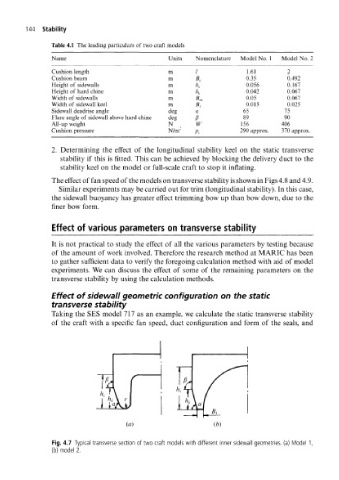
             Table 4.1  The  leading particulars of  two craft models
             Name                            Units   Nomenclature  Model No.  1  Model No. 2
             Cushion length                  m       /             1.61       2
             Cushion beam                    m       B c           0.35       0.492
             Height of sidewalls             m       h s           0.056      0.167
             Height of hard chine            m       h k           0.042      0.067
             Width of  sidewalls             m       B^            0.05       0.067
             Width of  sidewall keel         m       fi.           0.015      0.025
             Sidewall deadrise angle         deg     a            65         75
             Flare angle of  sidewall above hard chine  deg  ft   89         90
             All-up weight                   N       W           156        406
             Cushion  pressure               N/m :   p c         290 approx.  370 approx.

             2.  Determining  the  effect  of  the  longitudinal  stability  keel  on  the  static  transverse
                stability  if  this is fitted.  This  can  be achieved  by blocking the  delivery duct  to  the
                stability keel on  the model  or full-scale craft to  stop it  inflating.

             The effect  of fan speed of the models on transverse stability is shown in Figs 4.8 and 4.9.
               Similar experiments may be carried  out for trim (longitudinal stability). In this case,
             the sidewall buoyancy has greater effect  trimming bow up than  bow down,  due to  the
             finer bow form.


             Effect  of  various  parameters  on transverse  stability

             It  is not  practical  to  study the  effect  of  all the various parameters  by testing  because
             of  the amount of  work involved. Therefore the research method  at MARIC has  been
             to  gather  sufficient  data to  verify  the foregoing calculation method  with aid of  model
             experiments.  We can  discuss  the  effect  of  some  of  the  remaining parameters  on  the
             transverse stability by using the calculation  methods.
             Effect  of  sidewall  geometric  configuration  on  the  static
             transverse  stability
             Taking  the  SES model  717 as  an  example,  we calculate  the  static transverse stability
             of  the  craft with  a  specific  fan  speed,  duct  configuration  and  form  of  the  seals,  and


                                  (fl)


             Fig.  4.7  Typical transverse section  of two  craft  models with different  inner  sidewall  geometries, (a) Model
             (b)  model  2.

