


Page 158 - Theory and Design of Air Cushion Craft
P. 158
Static  transverse  stability of  SES on  cushion  141

          4.  The gaps between the lower edge of both  bow and  stern  seals and  the base-line are
             equal.

          Calculation  of  static transverse  stability  for  an  SES without LSK

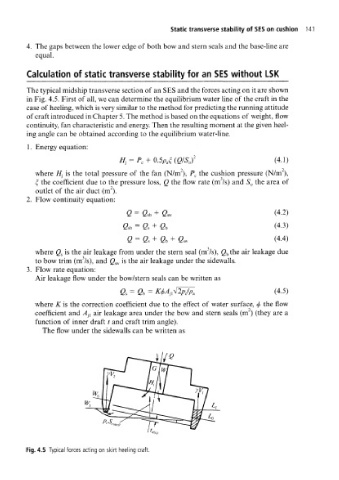
          The typical midship transverse section of an SES and the forces acting on it are shown
          in Fig. 4.5. First  of  all, we can determine the equilibrium  water line of  the craft  in the
          case of heeling, which is very similar to the method  for predicting  the running  attitude
          of craft introduced  in Chapter  5. The method  is based on the equations  of  weight, flow
          continuity, fan characteristic and  energy. Then  the resulting moment  at the given heel-
          ing angle can be obtained  according  to  the equilibrium water-line.
          1.  Energy  equation:
                                                   (Q/S 0} 2                  (4.1)
             where  H }  is the  total  pressure  of  the  fan  (N/m~),  P c  the  cushion  pressure  (N/nT),
             £ the  coefficient  due  to  the  pressure  loss,  Q the flow rate  (m /s) and  S 0 the  area  of
             outlet  of  the  air duct  (m").
          2.  Flow  continuity  equation:
                                      Q  =  &b  +  Qsw                        (4.2)
                                      sb  =  Q,  +  Gb                        (4.3)
                                      fi =  e,  + a, +                        (4.4)

            where  Q s is the  air  leakage from under  the  stern  seal  (m /s),  Q b the  air  leakage  due
             to  bow trim  (m /s), and  Q sw is the air leakage under  the  sidewalls.
             Flow  rate  equation:
            Air  leakage flow under  the bow/stern  seals can be written as

                                    fi s = fi b =                             (4.5)
            where  K  is the  correction  coefficient  due  to  the  effect  of  water  surface,  </>  the  flow
            coefficient  and  A- }1  air  leakage area  under  the  bow  and  stern  seals  (m ) (they  are  a
             function  of  inner draft  t and  craft trim  angle).
              The flow under  the sidewalls can be written as


          Fig.  4.5  Typical forces  acting on skirt  heeling craft.

