


Page 157 - Theory and Design of Air Cushion Craft
P. 157
140  Stability

                            BJB,

                           0.25


                           0.20


                           0.15


                           0.10


                           0.05


                                                                1 CIB C

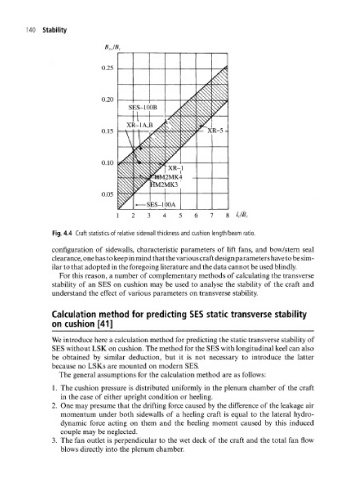
              Fig.  4.4  Craft statistics of relative sidewall thickness and cushion length/beam  ratio.
             configuration  of  sidewalls,  characteristic  parameters  of  lift  fans,  and  bow/stern  seal
             clearance, one has to keep in mind that the various craft design parameters have to be sim-
             ilar to that adopted  in the foregoing literature and the data cannot be used blindly.
               For this reason, a number of complementary methods  of calculating the transverse
             stability  of  an  SES on  cushion  may be used  to  analyse the  stability of  the  craft  and
             understand  the  effect  of  various parameters  on transverse stability.


             Calculation  method for   predicting  SES static  transverse  stability
             on  cushion [41]

             We introduce here a calculation  method  for predicting the static transverse stability of
             SES without LSK on cushion. The method for the SES with longitudinal keel can also
             be  obtained  by  similar  deduction,  but  it  is  not  necessary  to  introduce  the  latter
             because no  LSKs  are mounted  on modern  SES.
               The general assumptions for the calculation  method  are as  follows:
              1.  The  cushion  pressure is distributed uniformly  in the  plenum chamber  of  the  craft
                in the case of  either upright condition  or heeling.
             2.  One may presume that  the drifting  force caused by the difference  of  the leakage air
                momentum  under  both  sidewalls of  a  heeling craft  is equal  to  the  lateral hydro-
                dynamic  force  acting  on  them  and  the  heeling  moment  caused  by  this  induced
                couple may be neglected.
             3.  The  fan  outlet  is perpendicular  to  the  wet deck  of  the  craft  and  the  total  fan flow
                blows directly into the plenum  chamber.

