


Page 159 - Theory and Design of Air Cushion Craft
P. 159
142  Stability

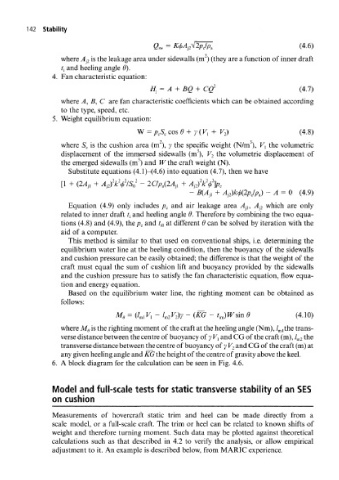
                                         Q^  = K^A^Jpl                           (4.6)
                        is the leakage area under sidewalls (m ) (they are a function of inner draft
                where A j2
                 and  heeling angle  6).
                t {
             4.  Fan characteristic  equation:
                                           =  A  + BQ  +  CQ 2                   (4.7)
                                        H }
                where A,  B, C  are fan characteristic coefficients  which can be obtained  according
                to  the type, speed, etc.
             5.  Weight equilibrium  equation:
                                     W  = p cS c  cos 0 +  y (V,  +  V 2)         (4.8)
                where  S c  is  the  cushion  area  (m"), y the  specific  weight (N/m  ),  V l  the  volumetric
                displacement  of  the  immersed  sidewalls (m),  V 2  the  volumetric  displacement  of
                the emerged  sidewalls  (m) and  W the craft  weight (N).
                  Substitute equations  (4.1)-(4.6) into equation  (4.7), then we have
                                                          2
                               2
                                                      2 2
                [1  +  (2A j{  + A ]2fk flS 2  ~  2C/p a(2A }l  +  A j2) k <f> ]p c
                                                   -  B(A ]l  + Ap)k<K2pM  -A = 0  (4.9)
                  Equation  (4.9)  only  includes p c  and  air  leakage  area  A-^,  A fl  which  are  only
                related  to inner draft { and  heeling angle 0. Therefore by combining the two  equa-
                                  t
                tions  (4.8) and  (4.9), the p c  and  r i0 at  different  0 can  be solved by iteration with the
                aid of  a computer.
                  This  method  is similar to  that  used  on  conventional  ships,  i.e. determining  the
                equilibrium water line at the heeling condition, then the buoyancy of  the sidewalls
                and cushion pressure can be easily obtained;  the difference  is that the weight of  the
                craft  must  equal  the  sum  of  cushion  lift  and  buoyancy  provided  by  the sidewalls
                and  the cushion  pressure has to  satisfy  the fan characteristic equation, flow equa-
                tion and  energy equation.
                  Based  on  the  equilibrium  water  line, the  righting moment  can  be  obtained  as
                follows:

                               M, =  (/ ml  K,  -  / m2 V 2}y -(KG-  t m) W sin 0  (4.10)
                where M e is the righting moment of the craft at the heeling angle (Nm), / ml the trans-
                verse distance between the centre of buoyancy of y V } and  CG of the craft (m), / m2 the
                transverse distance between the centre of buoyancy of y V 2 and CG of the craft (m) at
                any given heeling angle and KG the height of the centre of gravity above the keel.
                A block diagram  for the calculation can  be seen in Fig.  4.6.


             Model and full-scale tests for   static transverse stability of  an SES
             on  cushion

             Measurements  of  hovercraft  static  trim  and  heel  can  be  made  directly  from  a
             scale  model,  or  a  full-scale  craft. The  trim  or  heel can  be related  to  known  shifts  of
             weight  and  therefore turning moment.  Such data may be plotted  against  theoretical
             calculations  such  as  that  described  in  4.2  to  verify  the  analysis,  or  allow  empirical
             adjustment  to it. An  example is described  below, from  MARIC experience.

