


Page 149 - Theory and Design of Air Cushion Craft
P. 149
132  Steady drag forces
             MARIC experience and  ref. 39, it is suggested that the LCG  of  an  SES (also an  ACV)
             should normally be in the  range
                                   -       « -(0 ~  0.5)% [aft of CO.]
                                (X g  X C)/L C
                     is the LCG, measured from the stern,  the longitudinal centre of  buoyancy,
             where X g                               X c
             measured  from  the stern and  L c the cushion length.

              Effect  of  cushion  pressure-length  ratio

             Wave-making drag  increases in proportion  to  the  square  of  cushion  pressure.  Cush-
             ion pressure also  affects  the craft  outer draft,  therefore the cushion pressure seriously
             affects  the  craft  drag.  The  effect  of  cushion  pressure  on  hump  drag  will be  further
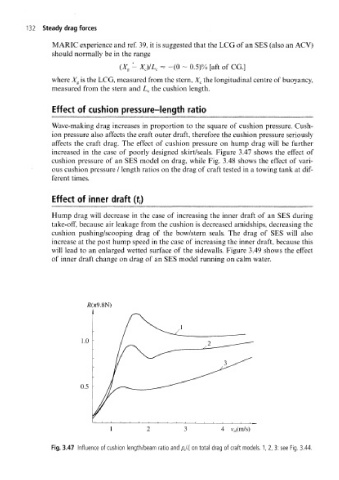
             increased  in  the  case  of  poorly  designed  skirt/seals. Figure  3.47  shows  the  effect  of
             cushion  pressure  of  an  SES model  on  drag, while Fig.  3.48 shows the  effect  of  vari-
             ous cushion pressure / length ratios on the drag of craft  tested in a towing tank at dif-
             ferent  times.


              Effect  of  inner draft

             Hump   drag  will  decrease  in the  case  of  increasing the  inner draft  of  an  SES during
             take-off,  because air leakage from  the cushion is decreased  amidships, decreasing  the
             cushion  pushing/scooping  drag  of  the  bow/stern  seals.  The  drag  of  SES  will  also
             increase at the post hump  speed  in the case of  increasing the inner draft, because this
             will  lead  to  an  enlarged wetted surface of  the  sidewalls. Figure  3.49 shows the  effect
             of  inner draft change on drag of  an  SES model running on  calm water.


                              1         2         3         4  v,,,(m/s)

             Fig. 3.47  Influence of cushion length/beam ratio and pj(  on total drag of craft models. 1, 2, 3: see Fig. 3.44.

