


Page 145 - Theory and Design of Air Cushion Craft
P. 145
128  Steady drag forces


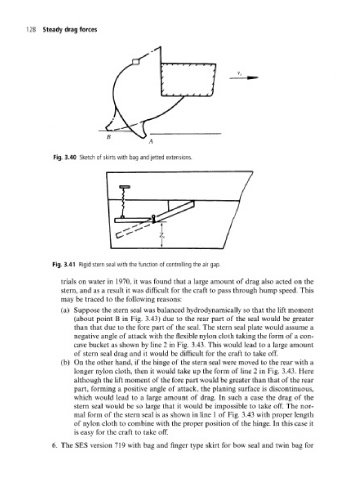
              Fig.  3.40  Sketch of skirts with  bag and jetted  extensions.


              Fig.  3.41  Rigid stern  seal with the function  of controlling  the air  gap.

                trials on water  in  1970, it was found  that  a large amount  of  drag  also acted  on  the
                stern, and  as a result it was difficult  for the craft  to pass through  hump  speed.  This
                may be traced  to the following  reasons:
                (a)  Suppose  the stern  seal was balanced  hydrodynamically so that  the lift  moment
                   (about  point  B in  Fig.  3.43) due  to  the  rear part  of  the  seal would be greater
                   than  that  due to the  fore part of  the seal. The stern  seal plate would assume a
                   negative angle of  attack with the flexible nylon cloth taking the form  of  a con-
                   cave bucket  as shown by line 2 in Fig.  3.43. This  would lead  to  a large  amount
                   of  stern  seal drag  and  it would be difficult  for the  craft  to  take off.
                (b)  On the other  hand,  if the hinge of  the stern seal were moved to the rear with a
                   longer  nylon cloth, then  it would take up  the form  of  line 2 in Fig.  3.43.  Here
                   although  the lift  moment  of the fore part would be greater than that of the rear
                   part,  forming a positive angle  of  attack,  the planing surface is  discontinuous,
                   which  would  lead  to  a  large  amount  of  drag.  In  such  a  case  the  drag  of  the
                   stern  seal  would  be  so large that  it would be  impossible  to  take  off. The  nor-
                   mal  form  of  the stern  seal is as shown in line  1 of  Fig.  3.43 with proper  length
                   of  nylon cloth  to combine with the proper  position  of the hinge. In this case it
                   is easy for  the  craft  to  take  off.
             6.  The  SES version  719 with bag  and  finger  type skirt  for  bow  seal  and  twin bag  for

