


Page 143 - Theory and Design of Air Cushion Craft
P. 143
126  Steady drag forces


                                                                    outer


                                                               inner
                                                (a)


                                                                       outer


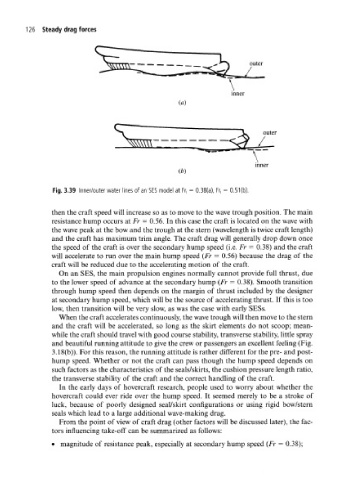
              Fig. 3.39  Inner/outer water  lines of an'SES  model at  Fr,  =  0.38(a),  Fr,  =  0.51(b).


             then the craft speed will increase so as to move to the wave trough position. The main
             resistance hump  occurs at Fr = 0.56. In this case the craft is located  on the wave with
             the wave peak at the bow and the trough at the stern (wavelength is twice craft length)
             and  the craft has maximum trim angle. The craft  drag  will generally drop down  once
             the  speed  of  the craft  is over the  secondary hump  speed  (i.e. Fr =  0.38) and  the craft
             will accelerate  to run  over the main hump speed  (Fr = 0.56) because  the  drag  of  the
             craft  will be reduced due to the accelerating motion  of  the  craft.
               On  an  SES, the main propulsion  engines normally cannot  provide  full  thrust,  due
             to the lower speed  of advance at the secondary hump (Fr  =  0.38). Smooth  transition
             through  hump  speed then  depends  on  the margin  of  thrust  included  by the  designer
             at secondary hump speed, which will be the source of accelerating thrust. If this is too
             low,  then transition  will be very slow, as was the  case with early SESs.
               When the craft accelerates continuously, the wave trough will then move to the stem
             and  the  craft  will be  accelerated,  so long  as the  skirt elements do  not  scoop;  mean-
             while the craft should travel with good  course stability, transverse stability, little spray
             and beautiful running attitude to give the crew or passengers an excellent feeling  (Fig.
             3.18(b)). For this reason, the running attitude  is rather different  for the pre- and  post-
             hump  speed. Whether  or  not  the  craft  can  pass  though  the hump  speed  depends  on
             such factors as the characteristics  of the seals/skirts, the cushion pressure length ratio,
             the transverse stability of  the craft  and  the correct handling of  the craft.
               In  the  early  days  of  hovercraft research,  people  used  to  worry about  whether  the
             hovercraft  could  ever ride  over  the  hump  speed.  It  seemed  merely to  be  a  stroke  of
             luck,  because  of  poorly  designed  seal/skirt  configurations or  using  rigid  bow/stern
             seals which lead  to a large additional  wave-making drag.
               From the point  of  view of  craft drag (other factors will be discussed later), the fac-
             tors influencing take-off can  be summarized  as follows:
             •  magnitude of  resistance peak,  especially at secondary hump  speed  (Fr = 0.38);

