


Page 138 - Theory and Design of Air Cushion Craft
P. 138
Skirt/terrain  interaction drag  121

                   0.12


                   0.08  -


                   0.04  -


                               0.4      0.6      0.8      1.0      1.2
                                          Fr,=vjgl c

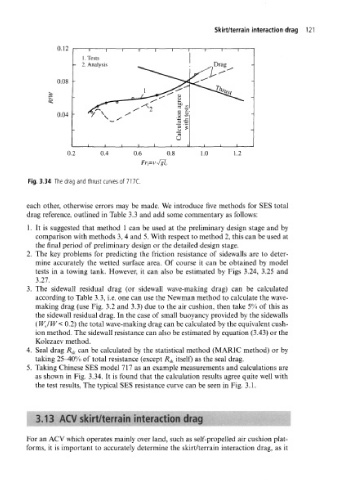
           Fig. 3.34  The drag and thrust curves of  717C.


          each  other, otherwise errors  may  be made.  We introduce five methods  for  SES total
          drag  reference,  outlined  in Table  3.3 and  add  some commentary  as  follows:
           1.  It  is suggested that  method  1 can  be used  at  the  preliminary design stage  and  by
             comparison  with methods  3, 4 and  5. With respect to method  2, this can be used at
             the final period of preliminary  design  or the detailed  design  stage.
          2.  The  key problems  for  predicting  the  friction  resistance  of  sidewalls are  to  deter-
             mine  accurately  the  wetted  surface  area.  Of  course  it  can  be  obtained  by  model
             tests  in  a  towing tank.  However,  it  can  also  be  estimated  by  Figs  3.24,  3.25  and
             3.27.
          3.  The  sidewall  residual  drag  (or  sidewall  wave-making  drag)  can  be  calculated
             according  to  Table 3.3, i.e. one can use the Newman method  to calculate the wave-
             making drag (use Fig.  3.2 and  3.3) due to  the air cushion,  then take  5% of  this as
             the  sidewall residual drag. In  the case of  small buoyancy provided by the sidewalls
             (WJW<   0.2) the total wave-making drag can be calculated by the equivalent cush-
             ion method. The sidewall resistance can also be estimated by equation  (3.43) or the
             Kolezaev method.
          4.  Seal drag R^  can be calculated  by the  statistical  method  (MARIC  method)  or by
             taking 25-40% of  total  resistance (except R sk  itself)  as the  seal drag.
          5.  Taking Chinese  SES model  717 as an  example measurements and  calculations  are
             as shown in Fig.  3.34.  It  is found  that  the calculation  results agree quite well with
             the  test results, The typical SES resistance curve can  be seen in Fig.  3.1.


            '3.13  ACV skirt/terrain    interaction  drag   :  ;  ;  ;  '  ;  'ih/rh^l

          For  an ACV which operates mainly  over land,  such  as self-propelled  air cushion plat-
          forms,  it is important  to  accurately determine the  skirt/terrain interaction  drag,  as it

