


Page 133 - Theory and Design of Air Cushion Craft
P. 133
Total ACV and  SES drag over water  117

          area  of  the  sea-water inlet (m),  C 0 the drag coefficient  due to  sea-water strainers, and
          v  the  craft speed (m/s).
            There are a number  of methods for predicting the appendage  drag.  In this  respect,
          there is no  difference  between the  appendages  of  SES and  planing hulls, or  displace-
          ment  ships: the data from  these can  therefore be used for reference.


             3,12  Total ACV and SB      drag over water


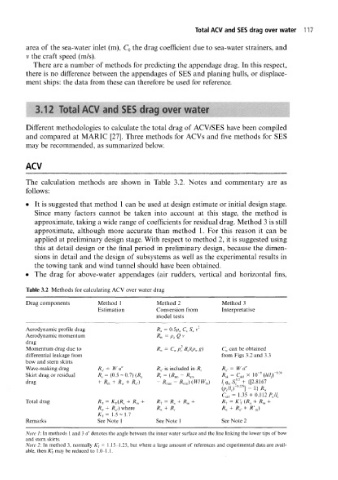
          Different  methodologies to calculate the total drag  of  ACV/SES have been compiled
          and  compared  at  MARIC  [27].  Three methods  for  ACVs and five methods  for  SES
          may be recommended,  as summarized below.

          ACV

          The  calculation  methods  are  shown  in  Table  3.2.  Notes  and  commentary  are  as
          follows:

          •  It is suggested that method  1 can be used at design estimate or initial design stage.
             Since  many  factors  cannot  be  taken  into  account  at  this  stage,  the  method  is
             approximate, taking a wide range of  coefficients  for residual drag. Method  3 is still
             approximate,  although  more  accurate  than  method  1.  For  this  reason  it  can  be
             applied  at preliminary design stage. With respect to method  2, it is suggested using
             this  at  detail design  or  the final period  in preliminary design, because  the dimen-
             sions in detail  and  the  design of  subsystems as well  as the  experimental results in
             the towing tank  and  wind tunnel should  have been  obtained.
          •  The  drag  for  above-water  appendages  (air  rudders,  vertical  and  horizontal fins,

          Table 3.2  Methods for calculating ACV over water drag
          Drag components     Method 1        Method 2          Method 3
                              Estimation      Conversion  from  Interpretative
                                              model tests
          Aerodynamic profile drag
          Aerodynamic momentum
          drag
          Momentum drag due to                                  C w can  be obtained
          differential  leakage  from                           from  Figs 3.2 and  3.3
          bow and stern skirts
          Wave-making drag    /?„.  =  W a"   R,f  is included  in  R r  R a,=  Wa"
                                                                           6
          Skirt drag or residual  R s = (0.5 ~ 0.7)  (R, t  R, = (R lm-  R jm  R A =  C skl :X  10" (/i//,)  °' 34
          drag                +  R m  + R v  + ,,)  -  R mm -  R wm)(W/W m)  {[2.8167
                                       R a
                                                                /J q
                                                                  " C: 5 t
                                                                cl,  =  1.35 +  0.112 PJl c
                                                                      (1
          Total drag          RT  = K T(R d  + R m +  R 7  =  R a  + R m +  RT  =  K'j ^  + R m  +
                              R n + R a.) where  R-A  ~^  -*^r  R^.  ~t~  R a» + R', k)
                              K T=  1.5-1.7
          Remarks             See Note 1      See Note 1        See Note 2
          Note  1: In methods  1 and  3 a" denotes the angle between the inner water surface and  the line linking the lower tips of  bow
          and  stern skirts.
          Note 2: In method  3, normally Kj  =  1.15-1.25, but  where a large amount of  references and  experimental data are avail-
          able, then  K'-f  may  be reduced  to  1.0-1.1.

